Zepbound Injection Site Rotation: Simple Weekly Plan
Learn where to inject Zepbound, how to rotate sites each week, and how to track your injection history without guessing.
A note from the editors. This article is for informational purposes only and does not constitute medical advice. Always consult your physician or qualified health provider before making changes to your medication or treatment plan.
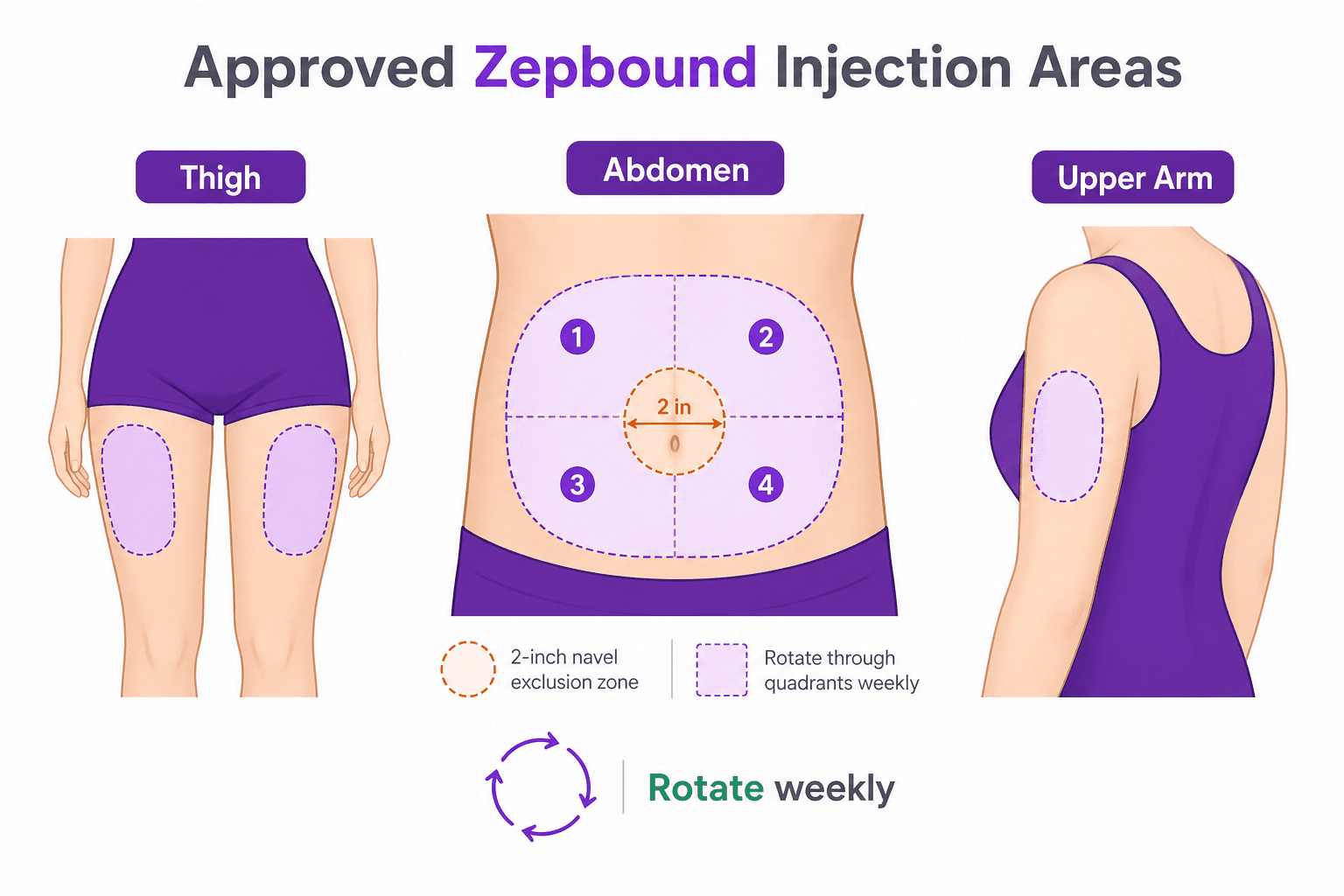
Zepbound injection site rotation means choosing a different injection spot for each weekly dose, even if you stay in the same body area. The FDA-approved areas are the abdomen, thigh, and back of the upper arm, and Lilly says not to use the same exact site for each injection.
Most people do not need a complicated system. You need a rotation pattern you can remember, a way to avoid the same spot twice, and a habit of checking the skin before every dose.
Quick answer: Rotate Zepbound by changing the exact injection spot every week. You can use your abdomen or thigh yourself, while the back of the upper arm is usually easier when another person gives the injection.
Where can you inject Zepbound?
Zepbound can be injected under the skin of the stomach area, thigh, or back of the upper arm. The stomach and thigh are the easiest self-injection sites for most people. Lilly's instructions say another person should give the injection if you use the back of the upper arm.
Abdomen: the easiest place to build a routine
The abdomen is often the simplest Zepbound injection area because you can see it, reach it, and divide it into repeatable zones. Lilly's instructions say to stay at least 2 inches away from the belly button when injecting into the stomach area.
Think of the abdomen as four quadrants: upper right, lower right, lower left, and upper left. If your clinician has not told you to avoid the abdomen, this four-zone pattern gives you a clean monthly rotation without needing to use the thigh or arm. Avoid scars, irritated skin, bruises, stretch marks that feel tender, or any area that looks inflamed.
GlucoPal's injection site body map lets you tap the exact area you used, so next week's dose does not rely on memory.
Thigh: useful when your abdomen needs a break
The thigh is another FDA-approved Zepbound injection area and can be easier if your abdomen is sore, bruised, or irritated. Use the front of the thigh where you have enough soft tissue, and choose a different spot each time.
Many people alternate left and right thigh as part of a broader pattern. For example, abdomen week 1, opposite abdomen week 2, right thigh week 3, left thigh week 4. If thigh injections feel more uncomfortable for you, do not force that site without asking your clinician. Comfort matters because consistency matters.
Upper arm: approved, but harder to do alone
The back of the upper arm is an approved Zepbound injection site, but it is awkward to reach safely by yourself. Both the FDA label and Lilly's instructions describe the upper arm as a site another person can use.
If you have a partner, family member, or caregiver helping with injections, the upper arm can add more rotation options. If you are injecting alone, the abdomen and thigh are usually more practical. Do not twist into an unstable position just to include the arm. A steady, visible site is better than a technically approved site you cannot reach well.
| Injection area | Good for | Watch out for |
|---|---|---|
| Abdomen | Easy self-injection, simple four-zone rotation | Stay at least 2 inches from the belly button |
| Thigh | Visible, reachable, helpful when abdomen is sore | Some people find it more tender |
| Back of upper arm | Adds rotation options with help | Usually needs another person |
How should you rotate Zepbound injection sites each week?
A good Zepbound rotation plan changes the exact spot every week and gives each area time before it is reused. You can rotate within one body area, such as the abdomen, or rotate across abdomen, thigh, and upper arm if those sites work for you.
Simple 4-week abdomen rotation
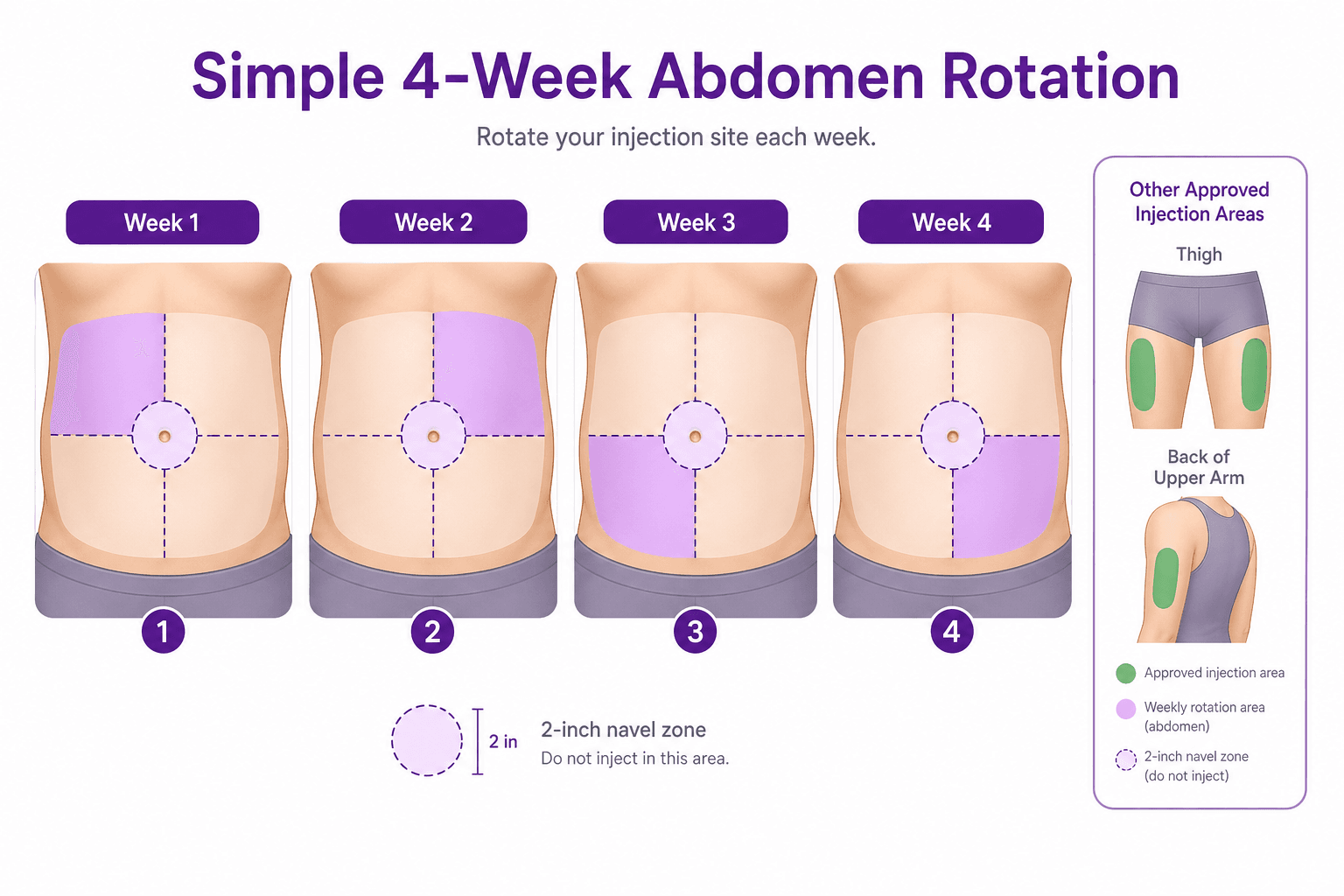
A four-week abdomen rotation is the easiest starting pattern: upper right abdomen, lower right abdomen, lower left abdomen, then upper left abdomen. Stay at least 2 inches away from the belly button, and move the injection spot slightly each time even when returning to the same quadrant.
This pattern works well for people who prefer the abdomen and do not want to add thigh or arm injections. It also keeps the routine simple enough to remember. The key is not the exact shape of the pattern. The key is avoiding the same small patch of skin week after week.
Abdomen-only rotation: Use four zones around the belly button, skipping the 2-inch area closest to the navel. Rotate clockwise or counterclockwise so every weekly dose has a planned spot.
Simple 6-week full-site rotation
A six-week rotation uses more body areas: right abdomen, left abdomen, right thigh, left thigh, right upper arm, left upper arm. This gives each general area more time before reuse, but it only makes sense if the upper arm is practical for you.
If you inject alone, modify it: right abdomen, left abdomen, right thigh, left thigh, upper right abdomen, upper left abdomen. A rotation plan should fit your real life. If the pattern is too fussy, you are more likely to abandon it.
Same area is okay if the exact spot changes
You do not have to use every approved body area to rotate correctly. Lilly states that you may use the same area of the body as long as you choose a different injection site within that area.
That matters for people who strongly prefer the abdomen or cannot comfortably use the thigh. If you stay with one area, make the rotation more specific. Instead of writing "stomach" every week, record "upper left abdomen" or "lower right abdomen." Keeping a weekly injection schedule and dose log makes that history visible, which is useful when every week starts to blur together.
Why does injection site rotation matter?
Injection site rotation matters because repeated injections into the same small area can irritate the skin and may contribute to tissue changes over time. Zepbound is once weekly, so the risk is different from daily insulin, but the practical advice is the same: give each spot time before reusing it.
Rotation reduces repeated trauma to one patch of skin
Every injection creates a tiny, localized skin event. Reusing the same point again and again gives that patch less time to recover. Mayo Clinic lists injection-site problems such as pain, redness, itching, swelling, tenderness, lumps, and bruising among possible effects to watch for with tirzepatide.
Rotation does not guarantee you will avoid irritation, and a mild reaction does not automatically mean something is wrong. But a planned rotation makes it easier to notice patterns. If the same area keeps getting sore, red, or lumpy, you have a clear reason to pause that area and ask your clinician what to do next.
Injection-site research supports systematic rotation
Most detailed research on rotation comes from insulin users, who inject much more often than Zepbound users. A 2025 systematic review and meta-analysis found incorrect injection site rotation was strongly associated with lipohypertrophy in people using insulin, with a pooled odds ratio of 8.85.
That statistic should not be copied directly onto once-weekly Zepbound use. It does show why clinicians take rotation seriously for injected medicines. The practical takeaway is conservative: do not keep using the same exact spot just because it worked last week.
Rotation helps you separate site issues from dose issues
Zepbound side effects can change because of dose increases, timing, meals, hydration, or individual sensitivity. If you also change injection sites randomly without recording them, it becomes harder to tell what happened.
Track the dose, date, site, and any symptoms in the same place, which is exactly what a dedicated Zepbound tracker app is built to do. If your nausea was worse after a dose increase, that is different from noticing that one area repeatedly becomes itchy or tender. GlucoPal's symptom journal can sit next to your injection history, so you can bring a cleaner pattern to your next appointment instead of a vague memory.
What should you avoid when choosing a Zepbound injection site?
Avoid injecting into the same exact spot, the 2-inch area around your belly button, irritated skin, bruises, scars, or areas that feel hard or tender. If you use other injectable medicines, ask your clinician how far apart to place the injections and whether any sites should be reserved.
Avoid the same exact site
The simplest rule is also the most important: do not use the same exact site each week. Lilly's instructions say to change or rotate the injection site with each weekly injection, even when using the same body area.
A written log works. A notes app works. A body map works better because it matches the decision you make in the moment: "Where did I inject last time?" The more specific the record, the less likely you are to accidentally reuse the same spot. If you want to compare tools that include a body map, see our roundup of the best Zepbound tracker apps.
Avoid irritated or unusual skin
Do not inject into skin that is red, swollen, bruised, infected-looking, unusually painful, or changed in a way you do not understand. If you notice a lump, rash, severe itching, spreading redness, or symptoms of an allergic reaction, contact your healthcare provider.
Mild injection-site tenderness can happen, but worsening or repeated reactions deserve attention. Take a photo if your clinician asks you to monitor a reaction, and record the site and date. That gives your care team better information than "it happened somewhere on my stomach."
Avoid making site changes to chase faster results
Do not switch injection sites because someone online said one site is stronger. The Zepbound label reports similar tirzepatide exposure after subcutaneous injection in the abdomen, thigh, or upper arm.
People can have personal comfort differences. One person may prefer the abdomen; another may prefer the thigh. But the goal is not to find a magic site. The goal is to inject safely, rotate consistently, and follow the instructions from your prescriber.
Best site for Zepbound: The best injection site is the approved area you can use correctly and rotate consistently. For many people, that starts with the abdomen or thigh.
FAQ
Can I inject Zepbound in the same general area every week?
Yes, you can use the same general body area if you choose a different exact spot each week. Lilly says you may use the same area of your body, but you should choose a different injection site in that area.
How far from my belly button should I inject Zepbound?
Lilly's instructions say to inject in the abdomen at least 2 inches away from the belly button. Many people use a four-zone abdomen rotation around that center area.
Is the thigh better than the stomach for Zepbound?
The thigh is not automatically better than the stomach. The Zepbound label reports similar exposure after injection in the abdomen, thigh, or upper arm. Choose the approved site you can use comfortably and rotate consistently.
Can I give myself Zepbound in the back of my upper arm?
The upper arm is an approved site, but Lilly and the FDA label describe it as a site another person can use. If you inject alone, the abdomen or thigh is usually easier and more stable.
What should I track after each Zepbound injection?
Track the date, dose, exact injection site, and any symptoms or skin reactions. The most useful note is specific, such as "lower right abdomen, 5 mg, mild redness for one day."
Sources
- Zepbound Prescribing Information - DailyMed - FDA label details on approved injection sites, weekly dosing, and similar exposure across abdomen, thigh, and upper arm
- Lilly Zepbound How to Use - manufacturer instructions on abdomen, thigh, upper arm, 2-inch belly button spacing, and weekly site rotation
- Mayo Clinic - Tirzepatide Subcutaneous Route - patient guidance on rotating injection areas and injection-site symptoms
- ClinicalTrials.gov NCT04050670 - study record for tirzepatide relative bioavailability by injection site
- Risk Factors for Lipohypertrophy in People With Insulin-Treated Diabetes - Systematic Review and Meta-Analysis - injection-site rotation evidence from insulin-treated populations
Never inject the same site twice.
GlucoPal rotates injection sites for you, logs every dose, and keeps your Zepbound, Wegovy, or Mounjaro routine on track.
Get GlucoPal — FreeFree · No account required · iPhone
Continue reading
All articlesWegovy Pill Tracker: Daily Doses, Meals and Weight
Track daily Wegovy pills, meals, protein, water, symptoms and weight with GlucoPal for iPhone. See how to build a useful daily record.
Read articleApp ComparisonsMyFitnessPal GLP-1 Support vs GlucoPal: Should You Just Use MyFitnessPal? (2026)
MyFitnessPal GLP-1 Support vs GlucoPal compared on dose logging, injection sites, side effects, food tracking, exports, and price, checked against primary sources.
Read articleApp ComparisonsNoom GLP-1 vs GlucoPal: Program or Tracker? (2026)
Noom GLP-1 vs GlucoPal compared: Noom Med is a telehealth program, GlucoPal is the daily record. Tracking, exports, medication coverage, and pricing.
Read article