How to Manage GLP-1 Nausea (and What to Track)
GLP-1 nausea is common, usually peaks around dose increases, and often eases with time. Here is why it happens, how to ease it, and when to call a doctor.

By GlucoPal TeamReviewed 10 min read
Nausea is the most commonly reported side effect of GLP-1 medications like Zepbound and Wegovy, and for most people it is worst during the early weeks and around dose increases rather than at a steady dose. It usually eases as your body adjusts, though not for everyone. The tips below can help you feel more in control while you and your prescriber sort out what works.
A tracker or a blog post cannot decide whether a symptom is safe. That is a clinician's job. What you can do is manage the everyday queasiness sensibly, know which symptoms are red flags, and keep a clear enough record to bring to your next appointment. This post extends our broader guide to logging GLP-1 side effects, zoomed in on the single most common one.
Quick answer: GLP-1 medications affect stomach emptying and brain pathways involved in nausea, but nausea alone cannot tell you which mechanism is responsible. It tends to peak in the first days after starting or after a dose increase, then ease over days to weeks. Smaller bland meals, eating slowly, and steady fluids may help. Follow your prescribed dose schedule and discuss troublesome symptoms with your prescriber. Get medical care for severe or persistent vomiting, signs of dehydration, or severe belly pain.
Why do GLP-1 medications cause nausea?
GLP-1 medications can affect both gastrointestinal movement and brain pathways involved in nausea. The relationship between these effects, appetite, and a person’s symptoms is complex; symptoms alone do not identify the cause. For many people, nausea is mild to moderate and fades as the body adjusts.
Slower stomach emptying does not fully explain nausea
GLP-1 receptor agonists can slow stomach emptying, including by reducing antral motility and increasing pyloric tone. However, a 2024 review in The Journal of Clinical Endocrinology & Metabolism reports that most studies found no or only weak correlations between measured gastric emptying and gastrointestinal symptoms, although some studies found a relationship. The review does not establish delayed emptying as the main cause of nausea.
You may notice fullness, queasiness after eating, or difficulty finishing a meal. Those experiences are useful to record, but they do not show how quickly your stomach empties or prove that delayed emptying caused the nausea. Discuss persistent or disruptive symptoms with your prescriber.
Your brain's nausea center also responds to GLP-1
Nausea is not only a stomach event. It is also driven by the brain. The area postrema, a small region in the brainstem, has a reduced blood-brain barrier and neurons that carry the GLP-1 receptor, so it samples hormones circulating in your blood. Research summarized in a study on brainstem nausea circuits (PMC) links this region to nausea signaling.
Brain pathways may contribute to nausea, but symptom timing does not show which pathway is responsible. Record dose changes and symptoms so you can describe the pattern to your prescriber.
Why nausea is common but not universal
Nausea is common, but it is far from guaranteed, and severity varies a lot from person to person. In the weight-loss trials, most people who felt nauseated described it as mild to moderate and short-lived, and most kept taking the medication. A minority never get much nausea at all.
Why some people feel it strongly and others barely notice it is not fully understood. Dose, how quickly the dose is raised, meal size and content, hydration, other medications, and individual biology all seem to play a role. The practical takeaway is that your experience is your own, and comparing your first weeks to someone else's online story is not a reliable guide.
When does GLP-1 nausea peak, and how long does it last?
GLP-1 nausea usually peaks in the first few days after starting the medication and again in the first days after each dose increase, then tends to ease over the following days to a couple of weeks. It clusters around dose escalation rather than at a steady dose. For many people it becomes much more manageable once they reach a maintenance dose.
Nausea clusters around dose increases, not steady state
The single most reassuring idea about GLP-1 nausea is that it tends to track your dose escalation, not your entire time on the drug. In SURMOUNT-1, the tirzepatide weight-loss trial published in NEJM, gastrointestinal events were generally mild to moderate and occurred mainly during dose escalation. That pattern matters: a rough few days right after a dose bump is very different from steady, ongoing sickness.
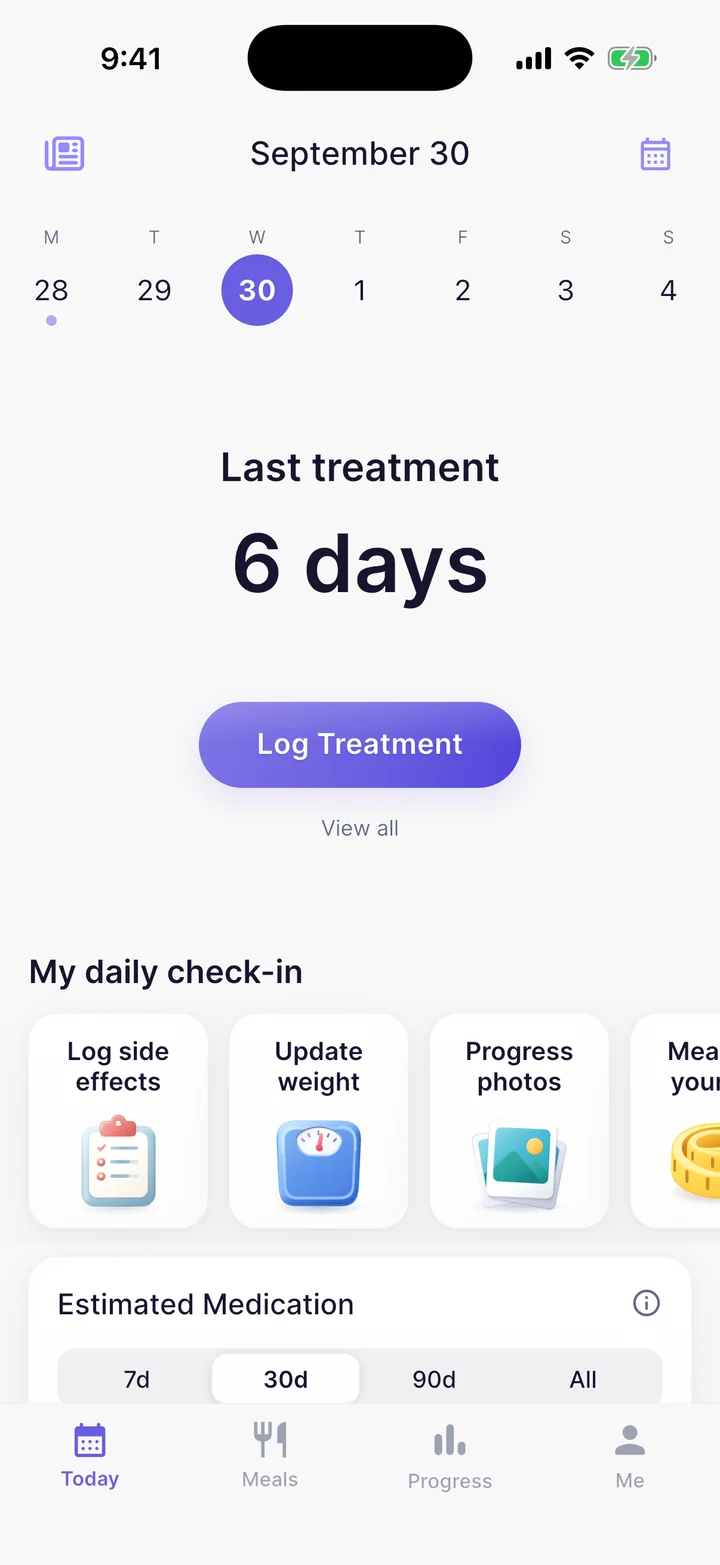
Because nausea tends to spike right after a dose increase, it helps to log each dose change so you can see whether a bad week lines up with titration or something else. GlucoPal keeps a dose history and injection log on one timeline, so a hard stretch is easy to place next to the date your dose actually changed.
How the Zepbound and Wegovy titration schedules line up with symptoms
Both Zepbound and Wegovy are designed to start low and step up slowly, which is meant to give your body time to adjust and limit nausea. Wegovy (semaglutide 2.4 mg) is titrated over roughly 16 to 20 weeks, moving up about every four weeks. Zepbound (tirzepatide) typically starts at 2.5 mg, then increases by 2.5 mg roughly every four weeks toward a maintenance dose.
Lined up against symptoms, that schedule means you may notice a wave of queasiness in the days after each step up, then relief as you settle in before the next increase. This is also why prescribers often hold a dose longer or move up more slowly when side effects are tough. The escalation is a schedule, not a race, and slowing it is a normal option to discuss.
What the trials actually found (SURMOUNT-1 and STEP 1 numbers)
The weight-loss trials put real numbers on how common nausea is. In SURMOUNT-1, nausea was reported by 24.6%, 33.3%, and 31.0% of adults on tirzepatide 5 mg, 10 mg, and 15 mg, versus 9.5% on placebo. That is roughly 1 in 4 to 1 in 3 people on the higher doses. In STEP 1, the semaglutide 2.4 mg weight-loss trial (NEJM), nausea was reported by 44.2% versus 17.4% on placebo.
| Medication and dose | Reported nausea | Placebo comparison | Trial |
|---|---|---|---|
| Tirzepatide 5 mg | 24.6% | 9.5% | SURMOUNT-1 |
| Tirzepatide 10 mg | 33.3% | 9.5% | SURMOUNT-1 |
| Tirzepatide 15 mg | 31.0% | 9.5% | SURMOUNT-1 |
| Semaglutide 2.4 mg | 44.2% | 17.4% | STEP 1 |
Two things are worth holding onto. First, a large share of people did report nausea, so if you feel it, you are in very normal company. Second, in these trials the GI events were generally described as transient and mild to moderate, and most participants kept taking the medication despite them.
How can you manage nausea on Zepbound or Wegovy day to day?
For everyday GLP-1 nausea, the most commonly recommended steps are eating smaller and blander meals, eating slowly and stopping when full, sipping fluids through the day, and avoiding very greasy or heavy foods. Do not raise your dose faster than prescribed to "push through." Talk to your prescriber about timing, pace, or medication options if nausea is disrupting your days.
Eating patterns that tend to help
Smaller, simpler meals are the change most people find helps first. Large or rich meals can be harder to tolerate when you feel nauseated; that does not establish the mechanism of your symptoms. Eating slowly, stopping at the first sign of fullness, and spacing food into smaller portions through the day tends to feel much better than three big plates.
Blander, lower-fat foods are usually easier than greasy or very sweet ones. Many people also find that hitting protein goals gets harder when they feel queasy, since appetite drops. Our guide to protein goals on GLP-1 medications covers gentler, protein-forward options for low-appetite days. GLP-1 nausea is not an excuse to skip protein, but it may change how you get there, for example through smaller high-protein snacks rather than large meals.
Hydration and timing
Steady fluids matter, both for comfort and because vomiting or reduced eating can lead to dehydration. Sipping water through the day, rather than gulping large amounts at once (which can worsen fullness), is a common suggestion. Cold or clear fluids and small amounts of ginger are gentle options many people try, though evidence is limited.
Timing can help too. Some people feel better taking their injection on a day when they can eat lightly, or in the evening so the roughest hours pass during sleep. Missed-dose and timing rules differ by medication, so follow your prescription instructions or ask your clinician rather than improvising.
Talk to your prescriber before changing your dose
If nausea is disrupting meals, sleep, or your day, that is a conversation for your prescriber, not a reason to quietly change your own dose. Because GI side effects concentrate during escalation, a common and reasonable option is to slow down: hold your current dose longer before stepping up, or increase more gradually. Your clinician may also discuss timing changes or, in some cases, medication to ease nausea.
The reason this matters is that most people do not have to abandon treatment over nausea. Across the pooled STEP 1-3 semaglutide weight-loss trials, gastrointestinal side effects led only about 4.3% of semaglutide participants to discontinue treatment, versus roughly 0.7% on placebo. In other words, the large majority who felt GI symptoms still continued, often after adjustments.
Does nausea mean the medication is working? (myth check)
Does nausea mean it's working? No. Nausea is a common side effect, not a measure of whether the medication is helping you lose weight. Plenty of people lose weight with little or no nausea, and feeling sick does not mean you are getting a "better" result. If you have no nausea, that is fine and not a sign of failure.
This myth can be harmful if it leads someone to tolerate severe symptoms or rush their dose up to feel more effect. The weight-loss benefit in the trials was driven by the medication and dose over time, not by how nauseated participants felt. Judge whether treatment is working with your prescriber using your actual results, not your queasiness.
When is GLP-1 nausea a red flag you should not track through?
Some symptoms should never wait for your next weekly review or appointment. Get medical care for severe or persistent vomiting, an inability to keep fluids down, signs of dehydration, or severe upper-abdominal pain, which can be a warning sign of pancreatitis. When symptoms are urgent, contact a clinician or seek emergency care instead of logging and waiting.
Signs of dehydration from vomiting or diarrhea
Nausea that turns into repeated vomiting or is paired with diarrhea can lead to dehydration, which needs attention. Patient information from MedlinePlus (NIH) advises reporting persistent nausea, vomiting, or diarrhea and warns about dehydration and kidney effects.
Common warning signs of dehydration include intense thirst, dry mouth, very dark urine or passing little urine, dizziness or lightheadedness, and unusual weakness or fatigue. If you cannot keep fluids down, or these signs appear, contact your healthcare provider promptly rather than trying to ride it out. Dehydration is one of the clearest examples of a symptom that a tracker should not manage on its own.
Severe or persistent abdominal pain and other urgent symptoms
Severe upper-abdominal pain deserves urgent attention because it can be a sign of pancreatitis, which the FDA medication guides for these drugs specifically warn about. According to the same MedlinePlus patient information, severe pain in the upper stomach area that may spread to the back, with or without vomiting, should prompt you to stop the medication and call your provider right away.
Other symptoms in the FDA labels warrant urgent care too, including signs of a serious allergic reaction (trouble breathing or swallowing, swelling of the face, lips, tongue, or throat), and gallbladder symptoms such as upper-belly pain with fever or yellowing of the skin or eyes. These are not "track it and see" situations. When something feels severe, sudden, or frightening, treat it as an emergency and get help.
What should you track to understand your nausea pattern?
To understand your nausea, track its severity, timing, and duration alongside your dose date and any dose changes, plus basic meal and hydration context. Over a few weeks this shows whether your rough days line up with dose increases (usually reassuring) or follow a different pattern worth raising with your prescriber. The goal is a clear record, not a self-diagnosis.
Log nausea severity and timing against your dose date
The most useful thing you can record is how bad the nausea was, when it started, and how long it lasted, placed next to the date of your last dose or dose change. That turns a vague memory ("I felt awful last week") into something you and your clinician can actually read: "moderate nausea for three days, starting the day after my step up to 5 mg."
In GlucoPal, you can note nausea severity, timing, and duration right next to your dose history, so the question becomes "what changed after this dose?" instead of a guess. A short entry beats a perfect one. On a bad day, even "day after dose, moderate nausea, no vomiting" is enough to see the pattern later.
Add meal, hydration, and dose-change context
Nausea rarely happens in a vacuum, so a little context makes your notes far more useful. Recording meal size and type, how much you drank, and whether it was a dose-increase week helps you and your prescriber see the everyday factors around a rough stretch, without turning it into detective work.
If you also log meals and water, you can review nausea alongside the everyday factors your prescriber may ask about, without building a spreadsheet. This does not prove any single food or fluid caused the nausea. It simply keeps the picture in one place so you are not reconstructing the week from memory at your appointment.
Bring the pattern to your next appointment
The payoff of tracking is a clearer conversation with your clinician. Instead of trying to recall which week was bad, you can show that nausea peaked for a few days after each increase and settled, or that it did not follow that pattern, which is exactly the kind of detail that helps a prescriber decide whether to slow titration, hold a dose, or look at something else.
Bring the timeline, not a diagnosis. A tracker organizes information; it does not decide what is safe or what your dose should be. Pair the pattern you recorded with your prescriber's judgment, and use urgent care for anything that crosses into the red-flag territory above.
FAQ
How long does GLP-1 nausea last?
For many people, nausea is worst in the first few days after starting or after a dose increase, then eases over several days to a couple of weeks as the body adjusts. In the weight-loss trials, GI events were generally described as transient and mild to moderate. It does not resolve for everyone, so tell your prescriber if nausea is severe, persistent, or getting worse.
Does nausea mean the GLP-1 medication is working?
No. Nausea is a common side effect, not a sign of how well the medication is working. Many people lose weight with little or no nausea, and feeling sick does not mean a better result. Judge whether treatment is working with your prescriber based on your actual results, not on how queasy you feel.
How do you reduce Zepbound or Wegovy nausea?
Commonly suggested steps include eating smaller, blander meals, eating slowly and stopping when full, avoiding greasy or very heavy foods, and sipping fluids through the day. Do not raise your dose faster than prescribed to push through it. If nausea disrupts your days, ask your prescriber about slowing titration, timing changes, or other options.
When does GLP-1 nausea peak?
Nausea tends to peak in the first days after starting the medication and again in the first days after each dose increase, as gastrointestinal side effects commonly cluster around dose escalation. It usually settles as you stay at a given dose. This is why tracking symptoms against your dose date is so useful.
Does nausea come back every time you increase your dose?
It can. Because nausea clusters around dose escalation, many people notice a wave of queasiness in the days after each step up, then relief as they settle in. It is often milder with each increase, but not always. If a dose increase brings back strong nausea, that is worth telling your prescriber, who may slow the pace.
Correction — October 6, 2026
Corrected the journal attribution for the gastric-emptying review and removed the claim that delayed emptying is the main cause of GLP-1 nausea. This correction concerns mechanism wording; the cited trial incidence figures retain their original sources.
Sources
- SURMOUNT-1 (Jastreboff et al.), New England Journal of Medicine, 2022: tirzepatide weight-loss trial nausea incidence by dose (24.6% at 5 mg, 33.3% at 10 mg, 31.0% at 15 mg vs 9.5% placebo) and note that GI events were mild to moderate and mainly during dose escalation (PubMed)
- STEP 1 (Wilding et al.), New England Journal of Medicine, 2021: semaglutide 2.4 mg weight-loss trial nausea incidence (44.2% vs 17.4% placebo)
- Gastrointestinal tolerability of once-weekly semaglutide 2.4 mg, pooled STEP 1-3 analysis (Wharton et al.), Diabetes, Obesity and Metabolism, 2022: GI-related treatment discontinuation (approximately 4.3% semaglutide vs 0.7% placebo, pooled across STEP 1-3)
- Clinical Consequences of Delayed Gastric Emptying With GLP-1 Receptor Agonists and Tirzepatide, The Journal of Clinical Endocrinology & Metabolism, 2024: gastric-emptying effects and the inconsistent relationship between measured emptying and gastrointestinal symptoms (PubMed)
- A brainstem circuit for nausea suppression, PMC: area postrema, its reduced blood-brain barrier, and GLP-1 receptor role in nausea signaling
- MedlinePlus (NIH), Semaglutide Injection: patient guidance on reporting persistent nausea, vomiting, and diarrhea, dehydration risk, and severe upper-abdominal pain as a pancreatitis warning
- DailyMed, Zepbound prescribing information: FDA medication-guide language on GI adverse reactions, dehydration, pancreatitis, and allergic-reaction warnings
- DailyMed, Wegovy prescribing information: FDA label language on common GI adverse reactions, titration schedule, dehydration, and pancreatitis warnings
- App Store, GLP-1 Tracker by GlucoPal: App Store listing used for GlucoPal feature references and iPhone availability
About the GlucoPal Editorial Team: GlucoPal makes the app discussed on this website. Our guides use product experience, FDA labels, manufacturer instructions, and the sources cited in each article. Editorial review is not clinical review. Read our editorial and corrections policy.
For information only, not medical advice. Talk to your prescriber before changing your medication or treatment plan.
Built for your weight-loss journey.
GlucoPal helps you log doses, rotate injection sites, and track symptoms for Zepbound, Wegovy, and Mounjaro in seconds.


Free to download and use · Optional Pro · iPhone and Android
Continue reading
All articlesGLP-1 Injection Tracker: Schedule, Site, and Dose Log
Use GlucoPal on iPhone or Android to log GLP-1 injection dates, doses, and sites, then review your medication history alongside symptoms and weight.
GLP-1 Side Effect Tracker: What to Log and When to Call
Log GLP-1 symptoms, appetite changes, injection-site reactions, and notes in GlucoPal on iPhone or Android, then review them alongside your dose history.
MyFitnessPal GLP-1 Support vs GlucoPal: Should You Just Use MyFitnessPal? (2026)
MyFitnessPal GLP-1 Support vs GlucoPal compared on dose logging, injection sites, side effects, food tracking, exports, and price, checked against primary sources.