Best Free GLP-1 Tracker App in 2026: How to Pick One That Fits
Most free GLP-1 tracker apps are freemium, not free. Here is what that really means, and how to pick the one that fits your medication and routine.

By GlucoPal TeamReviewed 10 min read
The best free GLP-1 tracker app is the one that fits your medication and the routine you will actually keep, not the one that shouts "free" the loudest. Almost every popular GLP-1 app, including GlucoPal and Shotsy, is freemium: free to download, with an optional paid tier. So the honest question is not "which app is free," it is "which free tier covers what I need."
This guide compares GlucoPal, Shotsy, MeAgain, MyNetDiary PlateAI and Glapp by workflow and plan access. All five rating figures come from Apple's US lookup API on October 6, 2026. Older competitor feature checks retain their stated dates; current plan limits should be checked in the app.
What does "free" really mean for a GLP-1 tracker app?
"Free" in this category almost always means freemium: the app is free to download and covers core tracking, while advanced features sit behind a paid tier. Shotsy, MeAgain, GlucoPal, and most others follow this pattern. Knowing where each app draws its free-versus-paid line matters far more than which app calls itself "free."
Most "free" GLP-1 apps are freemium, and that is fine if you know the line
Most GLP-1 tracker apps marketed as "free" are freemium. You can download and start logging without paying, but features like advanced analytics, projected medication-level charts, or unlimited history may require a subscription. This is a normal model, not a trick, as long as you know where the line sits.
The confusion comes from marketing. Some app sites describe themselves as "completely free" while still selling a yearly premium tier. That phrasing is what sends people searching "is Shotsy free" after they hit a locked feature. The useful framing is simple: nearly all of these apps are free to start, and most have an optional paid upgrade. Your job is to check whether the free tier covers the things you personally need, like your specific medication, injection-site tracking, or nutrition logging.
Free to download vs free forever: where the paywall usually sits
Free to download does not mean free forever. The paywall in GLP-1 apps usually sits around the same handful of features: estimated medication-level charts, deeper analytics, data export, and sometimes longer history. Core dose logging, reminders, and weight tracking are typically in the free tier.
GlucoPal is free to download and use. Standard US Pro is $9.99/month or $34.99/year and includes the estimated medication-level forecast chart and provider PDF. Discount offers, trial terms and feature access can vary, so check the in-app offer. Shotsy also has a free core tier and paid advanced features; review its current offer rather than treating an old store purchase range as a subscription price.
Why "which app is cheapest" is the wrong first question
Price should not be your first filter, because the cheapest app is useless if it does not support your medication or the routine you will keep. The better first question is fit: does this app track your exact GLP-1, handle injection-site rotation, and stay easy enough that you open it every dose day?
Research backs this up. In a 2026 JMIR analysis of 126,553 tirzepatide users, people who engaged with digital tracking lost 22.9% of body weight at 12 months, compared with 17.5% for non-engaged users. Engagement was associated with results; this observational comparison does not prove that a tracker caused the difference. So the smarter sequence is fit first, friction second, and price last. A free app you abandon in two weeks is more expensive, in the only way that matters, than a fitting app you keep.
Which free GLP-1 tracker app is the best fit for me?
Choose GlucoPal if you want individual meals, symptoms, photos and progress alongside your medication record on iPhone or Android. Compare Shotsy if you prefer medication records and daily nutrition totals, MeAgain for a companion, MyNetDiary PlateAI for an AI-led food diary, or Glapp for medication inventory and benchmarking. Check the medication and exact free features you need.
Quick-pick comparison table (US App Store ratings, October 6, 2026)
Best free GLP-1 tracker apps (2026): Choose by the record you want to keep, then check which parts require payment. The five apps below are free to download; that does not establish that every GLP-1 or nutrition feature is free.
| App | US rating (ratings) | Best fit for | Workflow | Plan check |
|---|---|---|---|---|
| GlucoPal | 4.81 (3,150) | Meals and medication in one record on iPhone or Android | Food search, barcode and photo entries; doses, sites, symptoms, measurements and photos; no account needed to start | Forecast chart and provider PDF require Pro; standard US $9.99/mo or $34.99/yr, with current terms in the app |
| Shotsy | 4.83 (33,064) | Medication records and daily nutrition totals | Doses, sites, charts, daily calorie/protein/water totals and exports | Check current free tracking and paid analytics access |
| MeAgain | 4.79 (35,959) | Companion-led tracking | Capy, food entry, goals and progress cards | Its dated free-plan page puts photo entry and Journey Cards in Premium; verify the current offer |
| MyNetDiary PlateAI | 4.74 (1,564) | An AI-led food diary with GLP-1 tools | Photo, barcode and voice food entry; nutrition and GLP-1 companion | Check current plan access; PlateAI is a separate listing from the main MyNetDiary calorie counter |
| Glapp | 4.74 (972) | Medication inventory and benchmarking | Dose/site records, medication curves and vial inventory | Food logging is not described; check current free and Max features |
All scores and counts above are from the same US storefront and October 6, 2026 lookup, rounded to two decimal places. They are ratings of the whole apps, not proof of clinical benefit or free-tier satisfaction. MyNetDiary PlateAI (ID 6739812031) was previously named GLP-1 Companion AI; its ratings are not the ratings of the separate MyNetDiary calorie-counter app.
GlucoPal: meals and medication in one record
GlucoPal fits people who want meal entries, medication history, symptoms, photos and measurements together on iPhone or Android. It is free to download and use with no account required to start. Pro adds the forecast chart and provider PDF; standard US pricing is $9.99/mo or $34.99/yr, with discounts and trial terms shown in the app.
GlucoPal records weekly injections and daily pills, sites, symptoms, weight and progress. Food search, barcode entry and AI meal-photo estimates support calories, protein, carbs, fat and fiber; water, body measurements and side-by-side photos add context beyond the scale. Apple Health works on iPhone and Health Connect on Android for supported records. Review food estimates and confirm your prescribed medication and current feature access.
Shotsy: medication records and daily nutrition totals
Shotsy and GlucoPal both work on iPhone and Android. Shotsy fits a medication-record routine with daily nutrition totals, maintenance tools and widgets. GlucoPal fits individual meal entry, photos and progress beside the medication timeline. Both offer estimated medication levels and dose-colored weight charts; check which features are included in the current plan.
Shotsy's US snapshot is 4.83 from 33,064 ratings on October 6. Rating counts describe the app's history, not the quality of its free tier or Android experience. Our GlucoPal vs Shotsy comparison explains the workflows.
MeAgain, MyNetDiary, and Glapp: where each fits
MeAgain emphasizes Capy and progress cards; MyNetDiary PlateAI emphasizes food entry and AI coaching; Glapp emphasizes medication records, inventory and trial benchmarking. These are different reasons to open a tracker, rather than a single ranked feature list.
Review the free and paid fields you need in each app. MeAgain's August 14 free-plan check placed photo food entry and Journey Cards in Premium. MyNetDiary PlateAI is the renamed GLP-1 Companion AI listing with a food-and-coaching workflow. Glapp describes injection-site records and medication inventory, so it should not be characterized as only a minimal shot log.
What features actually matter in a free GLP-1 tracker?
The features that matter most are medication coverage, injection-site rotation, built-in nutrition tracking, platform health integration and account setup. Price tier matters last. These are the things that decide whether an app fits your routine and whether you will keep using it.
Medication coverage: orals, compounded, and brand injections
Medication coverage is where many "free" GLP-1 apps quietly fall short. US readers may be on a brand injection, a compounded formulation, or an oral GLP-1, and not every app supports all three. If your app cannot log your exact medication and form, the rest of its features barely matter.
Confirm the exact medication and formulation in the current app. GlucoPal records injections and daily pills including the Wegovy pill, Rybelsus and Foundayo, plus compounded formulations. Other trackers also describe oral and compounded options; an abbreviated listing is not proof that a medication is absent. A tracking entry does not establish regulatory approval or a treatment recommendation.
Injection-site rotation and a body map
Follow your medication's injection instructions, including rotation. GlucoPal, Shotsy and Glapp describe site records; MyNetDiary also documents injection sites in its GLP-1 companion. Compare a field, a history view and a rotation map rather than assuming they are the same feature or that site tracking is absent.
The cited lipohypertrophy research concerns repeated self-injection, largely in insulin-treated populations; its prevalence figure is not a GLP-1 user risk estimate. Zepbound's patient instructions tell users to rotate injection sites. Record skin concerns and discuss persistent lumps or reactions with your clinician; see our site-rotation guide.
Nutrition, protein, and AI meal scanning without a second app
Built-in nutrition tracking matters because GLP-1 medications lower appetite, and many people struggle to hit protein targets. An app that logs protein, calories, and water alongside your dose saves you from running a separate calorie counter. AI meal scanning lowers the friction further by estimating macros from a photo.
This is where a dedicated calorie counter and a dedicated GLP-1 tracker pull in different directions. MyNetDiary leans nutrition-first, while apps like Shotsy and GlucoPal fold nutrition into a medication-centered timeline. GlucoPal adds protein, calorie, and water goals plus AI meal scanning, so you can log a meal in seconds instead of searching a database. If you want the reasoning behind targets, our guide to protein goals on GLP-1 covers how much to aim for and why it helps preserve muscle during weight loss.
Platform health integration, reminders and account setup
Health integration, reminders and account setup affect how many steps logging takes. Compare the records each platform can sync and whether a login is required before your first entry. Those usability choices do not establish a medical outcome.
GlucoPal supports Apple Health on iPhone and Health Connect on Android, dose reminders and a no-account start. Its privacy policy describes personal iCloud sync on iPhone and local tracking storage on Android. Integration does not mean identical records or backup behavior on both platforms; review permissions and the current policy.
Does it matter which tracker you use, or just that you use one?
Both matter, but consistency matters most. Research links engaging with tracking to better weight-loss outcomes, and the biggest risk is quitting the app, not picking a slightly "wrong" one. So pick an app that fits your medication and feels easy enough to keep using, then actually keep using it.
What the research says about tracking and weight loss
People who engage with digital tracking tend to lose more weight. In a 2026 JMIR analysis of 126,553 tirzepatide users, engaged users lost 22.9% of body weight at 12 months versus 17.5% for non-engaged users, and were 2.88 times more likely to reach at least 20% weight loss. This is an association, not proof that an app causes weight loss, but it is a strong reason to track.
The study does not establish a benefit from any particular app or feature. It supports asking whether a routine is practical to maintain. That points back to fit and friction: choose the tracker you will still be opening at month six, because that is the behavior tied to the outcome. Talk to your clinician about your own targets, since individual results vary widely.
The real risk is quitting the app, not picking the "wrong" one
A tracker is useful only if you keep records that matter to your care; medication persistence and app use are different outcomes. Real-world data shows only about 32.3% of patients remain persistent on GLP-1 therapy at one year. If staying on the medication is hard, staying engaged with a tracker is part of what helps you notice progress and problems early.
That reframes the whole decision. Do not agonize over which app has one extra chart. Pick the one that supports your medication, makes daily logging fast, and does not require a frustrating setup, then commit to it. A low-friction app you keep open beats a feature-packed app you delete. If side effects are your main worry, an app with a side-effect journal tied to your dose timeline can help you spot patterns worth raising with your prescriber.
Is Shotsy free, and is it worth paying for?
Shotsy is free to download with a core tracking tier and optional paid advanced features. Check its current in-app offer for price, trial terms and the exact tools included. An old App Store or Google Play purchase range can combine different products and does not establish one subscription price.
Is the Shotsy subscription worth it, or is another app a better fit?
Consider a Shotsy subscription if its paid tools are features you will actually use. Android availability alone is not a reason to pay: both Shotsy and GlucoPal work on Android. Compare the free records and paid features that fit your routine.
Compare GlucoPal if you want individual food entries, sites, symptoms, progress photos and measurements together without an account to start. It is free to download and use; Pro adds the forecast chart and provider PDF at standard US $9.99/mo or $34.99/yr, subject to current offers and terms. Choose by workflow, not an assumed Android exclusion or annual-price equivalence.
FAQ
Is there a free GLP-1 tracker app?
Yes, several GLP-1 tracker apps are free to download and use, including Shotsy, GlucoPal, MeAgain, MyNetDiary, and Glapp. Most are freemium, meaning core tracking is free while advanced features (like medication-level charts) sit behind an optional subscription. Check each app's free tier against the features you actually need, especially support for your specific medication.
What is the best app to track GLP-1?
Choose GlucoPal for meals, medication, symptoms and progress in one record on iPhone or Android. Compare Shotsy for medication records and daily totals, MeAgain for Capy, MyNetDiary PlateAI for AI-led nutrition, or Glapp for inventory and benchmarking. Verify the exact medication and free features you need.
What is the difference between GlucoPal and Shotsy?
Both GlucoPal and Shotsy work on iPhone and Android and offer estimated medication levels and dose-colored weight charts. GlucoPal logs individual foods by search, barcode or photo and adds progress photos and measurements. Shotsy emphasizes medication records, daily calorie/protein/water totals, maintenance tools and widgets. Check current plan access for either app.
Product correction — October 6, 2026
GlucoPal works on iPhone and Android; barcode entry, fat/fiber, measurements and side-by-side photos are current shared capabilities. Standard US Pro is $9.99/month or $34.99/year, with discounts and terms shown in the app. All five ratings use one US cohort on October 6; other competitor checks retain their stated dates.
Sources
- JMIR (2026) - Digital engagement and tirzepatide weight loss outcomes (n=126,553) - engaged users lost 22.9% vs 17.5% of body weight at 12 months and were 2.88x more likely to reach at least 20% weight loss.
- PMC11293763 - Real-world GLP-1 persistence - only about 32.3% of patients remain persistent on GLP-1 therapy at one year.
- PMC5934253 - Lipohypertrophy prevalence - review of 26 studies (12,493 participants) finding ~38% prevalence among self-injecting patients.
- PMC11924065 - Injection-site rotation and lipohypertrophy risk - non-rotation of injection sites as a leading risk factor.
- DailyMed - Zepbound Prescribing Information - FDA labeling instructing patients to rotate injection sites.
- Lilly - How to Use Zepbound - manufacturer instructions for rotating within the abdomen, thigh, or upper arm.
- App Store — Shotsy — US rating cohort checked October 6, 2026; other dated feature checks retained.
- App Store — GlucoPal, Google Play, current product guide and privacy policy — US rating and owned-product facts corrected October 6, 2026.
- Apple US lookup — all five apps — same-storefront scores and counts, October 6, 2026.
- MyNetDiary PlateAI — current identity and published food/GLP-1 tools; MyNetDiary GLP-1 companion — site records and Premium medication tracking, checked October 6.
- MeAgain, free-plan guide and Glapp — rating identities; competitor plan descriptions retain their stated checks.
About the GlucoPal Editorial Team: GlucoPal makes the app discussed on this website. Our guides use product experience, FDA labels, manufacturer instructions, and the sources cited in each article. Editorial review is not clinical review. Read our editorial and corrections policy.
For information only, not medical advice. Talk to your prescriber before changing your medication or treatment plan.
Built for your weight-loss journey.
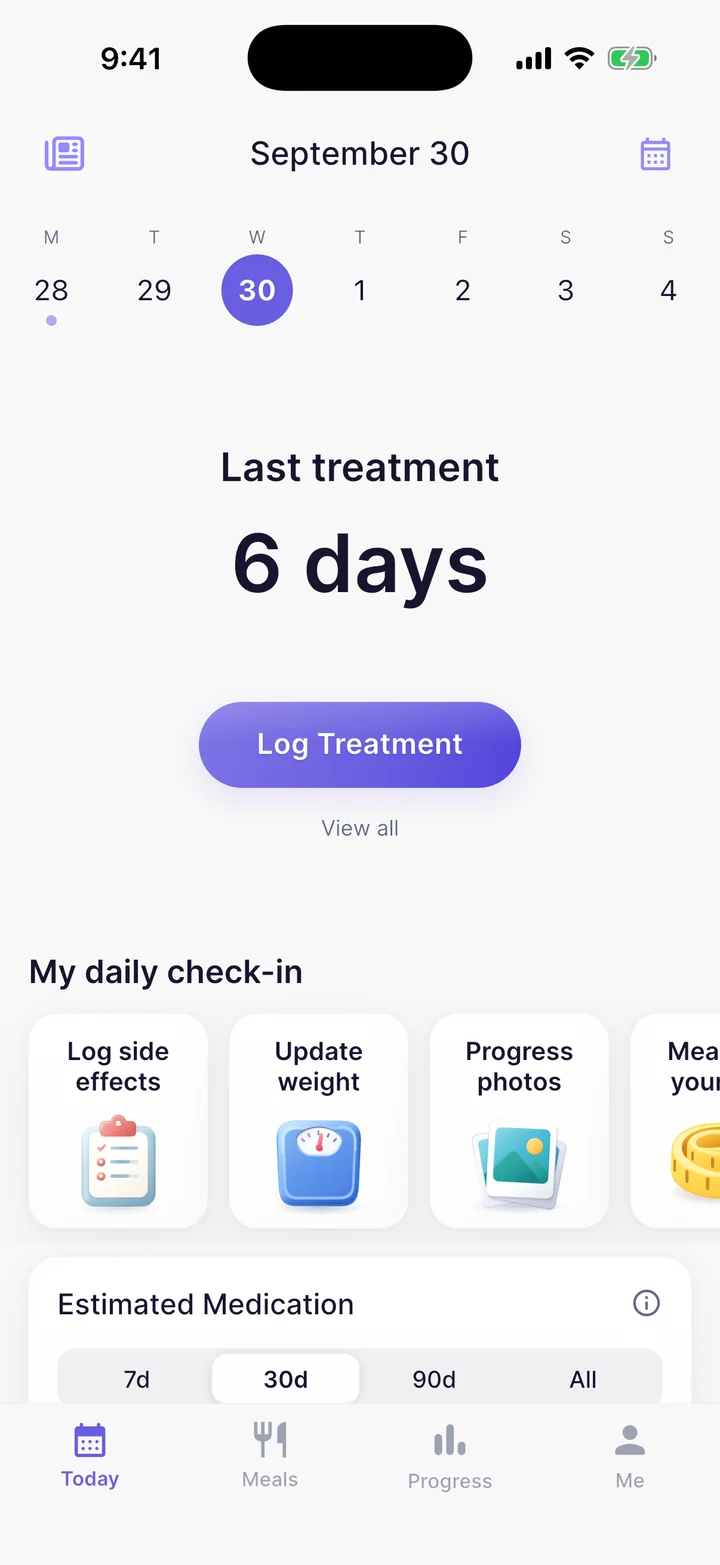
GlucoPal helps you log doses, rotate injection sites, and track symptoms for Zepbound, Wegovy, and Mounjaro in seconds.


Free to download and use · Optional Pro · iPhone and Android
Continue reading
All articlesMyFitnessPal GLP-1 Support vs GlucoPal: Should You Just Use MyFitnessPal? (2026)
MyFitnessPal GLP-1 Support vs GlucoPal compared on dose logging, injection sites, side effects, food tracking, exports, and price, checked against primary sources.
Noom GLP-1 vs GlucoPal: Program or Tracker? (2026)
Noom GLP-1 vs GlucoPal compared: Noom Med is a telehealth program, GlucoPal is the daily record. Tracking, exports, medication coverage, and pricing.
Lilly Health vs GlucoPal: The Official Zepbound App Compared (2026)
Lilly Health vs GlucoPal compared on medication coverage, food logging, side effects, injection sites, exports, and privacy, verified against both App Store listings.