Mounjaro Weight Loss Calculator
How much weight do people actually lose on Mounjaro? This calculator maps the SURMOUNT-1 trial averages for tirzepatide onto your starting weight in kilograms, your maintenance dose, and how long you have been on it.
From the SURMOUNT-1 trial (Jastreboff et al., NEJM 2022) · Free, no sign-up
Your details
Mounjaro weight loss chart
SURMOUNT-1 average, mapped to your starting weight
−00.0−20.9kg
20.9% of body weight
100.0 kg 79.1 kg
Out of 100 people on 15 mg
A trial average is not a prediction. Weeks between trial timepoints are estimated. Source: SURMOUNT-1, Jastreboff et al., NEJM 2022
See your real curve
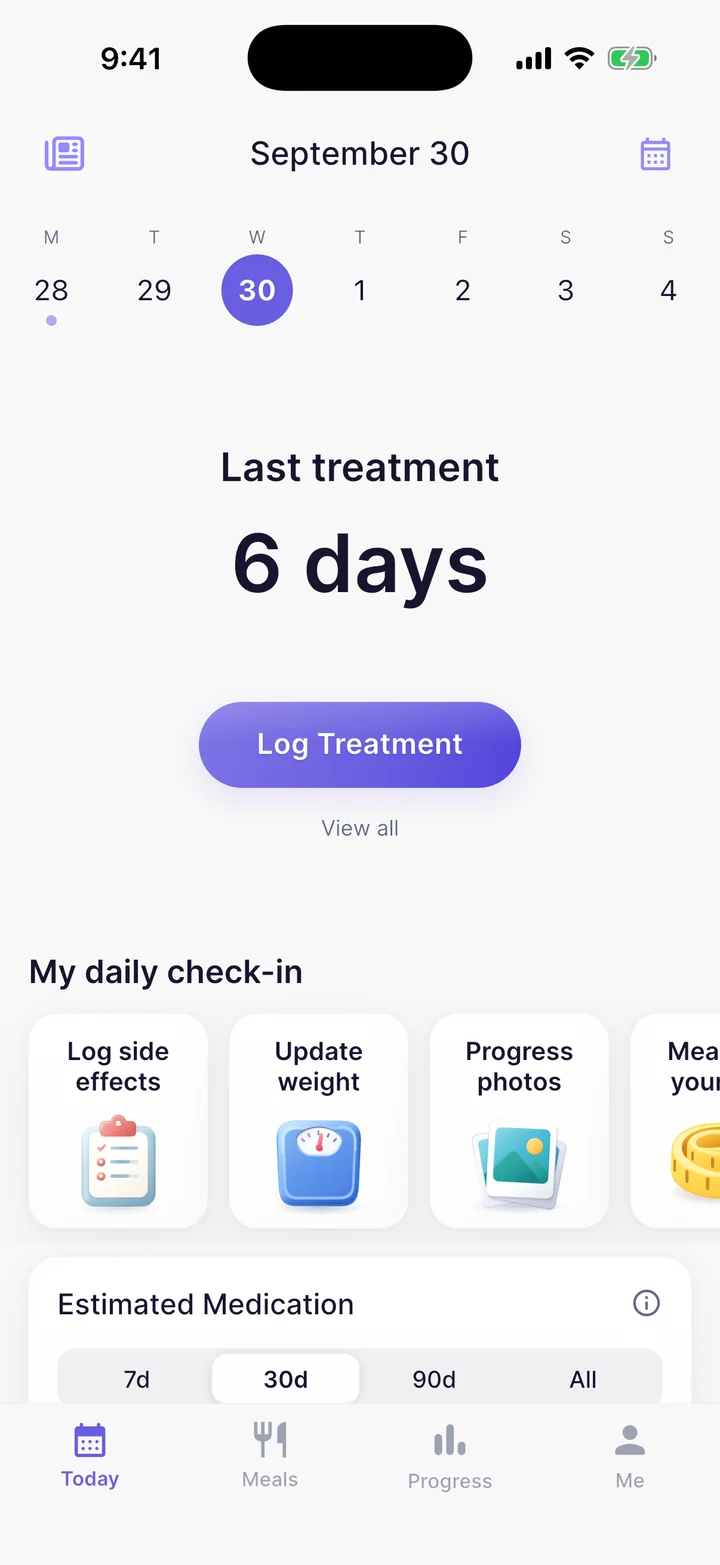
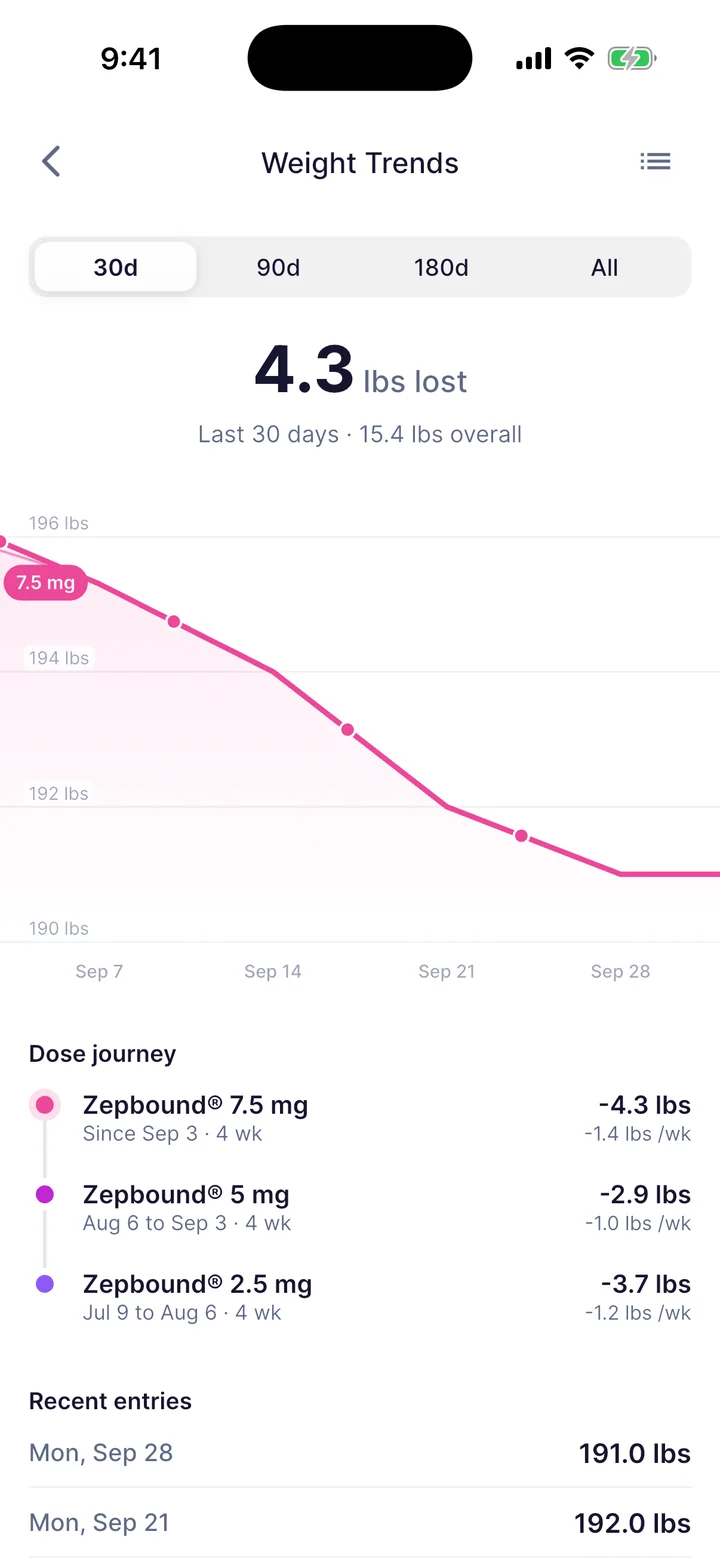
Log weigh-ins and doses, and GlucoPal charts your weight trend by dose.

Quick answer: In SURMOUNT-1, adults with obesity and without diabetes lost an average of 15.0% of body weight on tirzepatide 5 mg, 19.5% on 10 mg and 20.9% on 15 mg over 72 weeks, alongside a reduced-calorie diet and more activity. Diet and exercise alone averaged 3.1%. From a 100 kg starting weight that is roughly 15.0 kg, 19.5 kg and 20.9 kg. The calculator above puts your own starting weight through the same curve, and the free GlucoPal app for iPhone and Android tracks what you actually lose against it.
Educational reference only, not medical advice and not a prediction of individual results. Trial participants used the medication alongside a reduced-calorie diet and increased activity. Talk to your prescriber about what to expect for you.
Mounjaro weight loss by dose and month
SURMOUNT-1 (Jastreboff et al., NEJM 2022) ran for 72 weeks in adults with obesity (BMI 30+, or 27+ with a weight-related condition), without diabetes. Average baseline weight was 104.8 kg, so the 15 mg average of 20.9% works out at roughly 22 kg, or about three and a half stone, for a typical participant.
| Time point | Mounjaro 5 mg | Mounjaro 10 mg | Mounjaro 15 mg |
|---|---|---|---|
| 3 months (wk 13) | −7.3% | −8.9% | −9.6% |
| 6 months (wk 26) | −11.4% | −14.1% | −15.2% |
| 9 months (wk 39) | −13.4% | −17.0% | −18.2% |
| 12 months (wk 52) | −14.4% | −18.5% | −19.8% |
| 15 months (wk 65) | −14.8% | −19.3% | −20.7% |
| Trial end | −15.0% | −19.5% | −20.9% |
Intermediate months are estimated from the published curve shape and verified anchors; the trials publish week-by-week values only as figures. The trial-end row is the published result.
The doses separate early and stay separated. By month 6 the estimated 15 mg curve sits near 15.2% against 11.4% on 5 mg, and the gap at the 72-week endpoint is 5.9 percentage points. Dose is the single biggest lever in this dataset.
Why 7.5 mg and 12.5 mg are missing from the calculator
Mounjaro is available in six strengths: 2.5, 5, 7.5, 10, 12.5 and 15 mg. SURMOUNT-1 only randomised participants to three maintenance doses, 5 mg, 10 mg and 15 mg, so those are the only doses with a published weight-loss result. We have deliberately not invented curves for 7.5 mg and 12.5 mg.
If you are on one of those strengths, read between the two curves either side of it. Someone maintaining on 12.5 mg sits somewhere between the 10 mg and 15 mg lines, which at the 72-week endpoint means somewhere between 19.5% and 20.9%. That is a wide enough band to be honest about, and narrower than the spread between individuals on any single dose.
The 2.5 mg strength is a starting dose rather than a maintenance dose. It is there to let your body adjust, and it is not expected to deliver the full effect on its own.
Why your first months look slower than the curve
Nobody starts on a maintenance dose. Tirzepatide begins at 2.5 mg once weekly for four weeks, moves to 5 mg, and then rises in 2.5 mg steps no sooner than every four weeks. The earliest anyone reaches 15 mg is around week 20, so most of the first four to five months are spent climbing rather than sitting at the dose the curve is named after.
That is why the trial curves are steepest through months 3 to 9 rather than in month 1. At week 12 the estimated 15 mg trajectory is only about 9.0%, well under half of where it finishes. If you are eight weeks in and comparing yourself to a headline number from week 72, you are comparing two different points on the same line.
Move the week slider on the calculator to where you actually are. What you want is your own trend against the curve at the same week, not against the endpoint.
The spread around the average
An average hides an enormous range. On 15 mg at 72 weeks, 90.9% of participants lost at least 5%, 83.5% of participants lost at least 10%, 70.6% of participants lost at least 15%, and 56.7% of participants lost at least 20%. More than half cleared 20%, and roughly one in ten did not reach 5%, on the same dose in the same trial.
A slow start is a weak signal. In a SURMOUNT-1 follow-up analysis, 18% of participants had lost less than 5% at week 12, yet 90% of that group still reached at least 5% by week 72. True non-response by the end of the trial was under 2%.
Which is the practical case for keeping your own record rather than eyeballing it. Weekly weigh-ins under the same conditions, logged next to your doses and side effects, tell you and your prescriber far more than any single comparison to a trial average. GlucoPal is the free app for iPhone and Android built for that record, and it works in kilograms or stone as well as pounds.
What this calculator can and cannot tell you
It is a reference point, not a forecast. The published endpoints at week 72 and the responder percentages above are verified trial numbers. Everything between those points is modelled: SURMOUNT-1 publishes its week-by-week trajectory only as a figure, never as a numeric table. We draw a standard saturating weight-loss curve through the verified anchors, hit the published endpoint exactly, and label every intermediate week as estimated.
We also use the conservative regulator-signed estimand throughout rather than the higher efficacy numbers quoted in press coverage, which is why you will see 20.9% here for 15 mg rather than the ~22.5% figure you may have read elsewhere.
Finally, the trial population may not be yours: BMI 30 or above, or 27 and above with a weight-related condition, no diabetes, and a structured diet and activity programme running alongside the medication. The numbers reflect medication plus lifestyle change, not medication on its own. They are educational, not medical advice.
FAQ
How much weight will I lose on Mounjaro in a month?
Very little of the eventual total, and that is expected. The estimated SURMOUNT-1 trajectory at four weeks is around 3.3%, because everyone is still on the 2.5 mg starting dose at that point. From 100 kg that is roughly 3.3 kg. Month one is about tolerating the medicine and getting the escalation under way, not about the number on the scales.
How much weight will I lose on Mounjaro in 3 months?
As a reference, the estimated trajectory at 13 weeks is near 9.6% on 15 mg, 8.9% on 10 mg and 7.3% on 5 mg. From a 100 kg starting weight, 9.6% is about 9.6 kg. Remember that at three months most people have not reached their maintenance dose yet, so early weeks understate where the curve ends up.
How much weight will I lose on Mounjaro in 6 months?
The estimated six-month values are about 15.2% on 15 mg, 14.1% on 10 mg and 11.4% on 5 mg. Months 3 to 9 are the steepest part of the trial curve, so this is the stretch where the trend is most visible week to week. Individual results varied widely in both directions.
Is Mounjaro the same as Zepbound?
Yes, in the sense that matters here. Both are tirzepatide at the same maintenance strengths. Mounjaro is the tirzepatide brand prescribed for weight management in the UK and Australia, and Zepbound is the brand prescribed for weight management in the United States. SURMOUNT-1 is the pivotal weight-loss trial behind both, so this calculator uses the same curves for either name.
Is Mounjaro or Wegovy better for weight loss?
There is a published head-to-head, so this does not rest on reading two trials against each other. In SURMOUNT-5, 751 adults with obesity and without diabetes were randomised to tirzepatide or semaglutide for 72 weeks, each titrated to their maximum tolerated dose. Tirzepatide averaged 20.2% weight loss against semaglutide's 13.7%, and 19.7% of the tirzepatide group lost at least 30% of their body weight against 6.9% on semaglutide. Two caveats: the trial was open-label, and it ran before the higher-dose 7.2 mg semaglutide injection existed, so its semaglutide arm was capped at 2.4 mg. Tolerability, availability, cost, and what your prescriber recommends all matter as much as the average, and plenty of people do very well on semaglutide.
Can I use this calculator if I am on 12.5 mg or 7.5 mg?
You can use it as a bracket. SURMOUNT-1 only studied 5 mg, 10 mg and 15 mg, so there is no published curve for 7.5 mg or 12.5 mg and we have not invented one. Read 7.5 mg as sitting between the 5 mg and 10 mg lines, and 12.5 mg as sitting between the 10 mg and 15 mg lines, which at 72 weeks means between 19.5% and 20.9%.
Does the calculator work in stone?
The calculator takes kilograms or pounds. To read a result in stone, divide the pounds figure by 14, or take the kilogram figure and multiply by 0.157. The GlucoPal app for iPhone and Android itself supports stone directly if that is how you weigh yourself.
Is this calculator free, and do I need to sign up?
Yes, it is free, and no sign-up or email is required. You see the full result instantly: the trial average for your starting weight, the month-by-month curve, and the responder milestones. The GlucoPal iOS app it comes from is also free to download.
Other medications
- Zepbound weight loss calculatorThe same tirzepatide data, set up in pounds for the United States.
- Wegovy weight loss calculatorAll three forms: the 2.4 mg injection, Wegovy HD 7.2 mg, and the 25 mg daily tablet.
- Foundayo weight loss calculatorThe daily orforglipron pill, from the ATTAIN-1 trial.
- Compare all four medicationsEvery trial average side by side in one table.
Sources
- Aronne et al., Tirzepatide as Compared with Semaglutide for the Treatment of Obesity (SURMOUNT-5), NEJM 2025
- Tirzepatide Once Weekly for the Treatment of Obesity (SURMOUNT-1), NEJM 2022
- Mounjaro EPAR and product information, European Medicines Agency
- Zepbound (tirzepatide) Prescribing Information, US DailyMed, for the dose escalation schedule
- FDA Statistical Review, NDA 217806 (intermediate week-20 anchors)
- Ard et al. 2025, early weight loss response in SURMOUNT-1
Built and maintained by GlucoPal, the free app for iPhone and Android for tracking GLP-1 weight loss medications. The GLP-1 Tracker by GlucoPal app is rated 4.8 stars from over 7,000 ratings worldwide and used by 100,000+ people. The calculator runs entirely in your browser and stores no health data.
You take your GLP-1s. We'll take care of the rest.