How Long Do GLP-1s Stay in Your System?
Semaglutide (Wegovy, Ozempic, Rybelsus) stays in your system for about 5 to 7 weeks after the last dose, tirzepatide (Zepbound, Mounjaro) and dulaglutide (Trulicity) for about a month, orforglipron (Foundayo) for about a week, and liraglutide (Saxenda, Victoza) for about 3 days. The difference is the half-life: about 1 week, 5 to 6 days, 5 days, 29 to 49 hours and 13 hours, per the FDA labels.
From the FDA labels on DailyMed · Free, no sign-up
At a glance
- Half-life
- about 5 to 6 days
- Peak after a dose
- 24 hours
- Steady state
- about 4 weeks
- Below 5% after stopping
- about 3 weeks
See your real levels
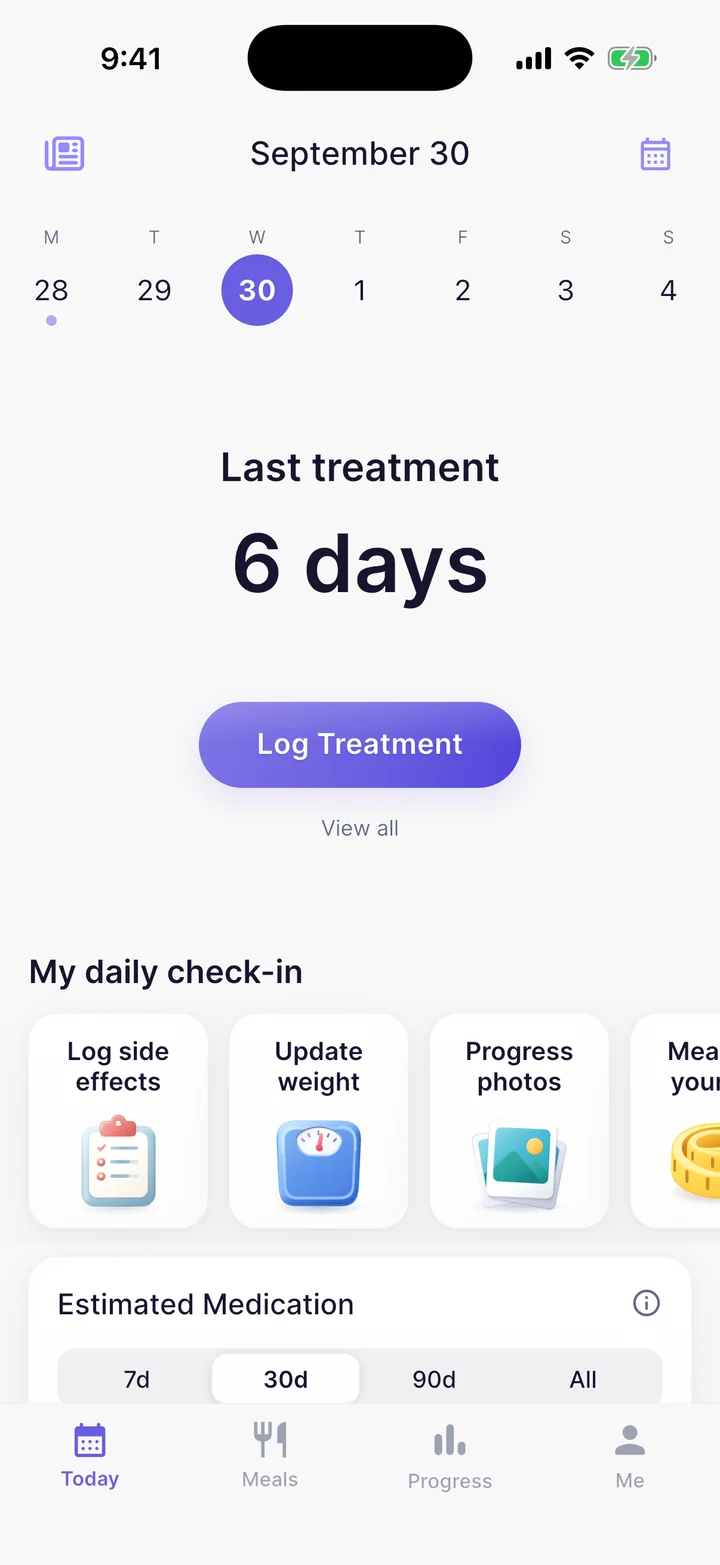
GlucoPal charts your estimated level from the doses you actually log.

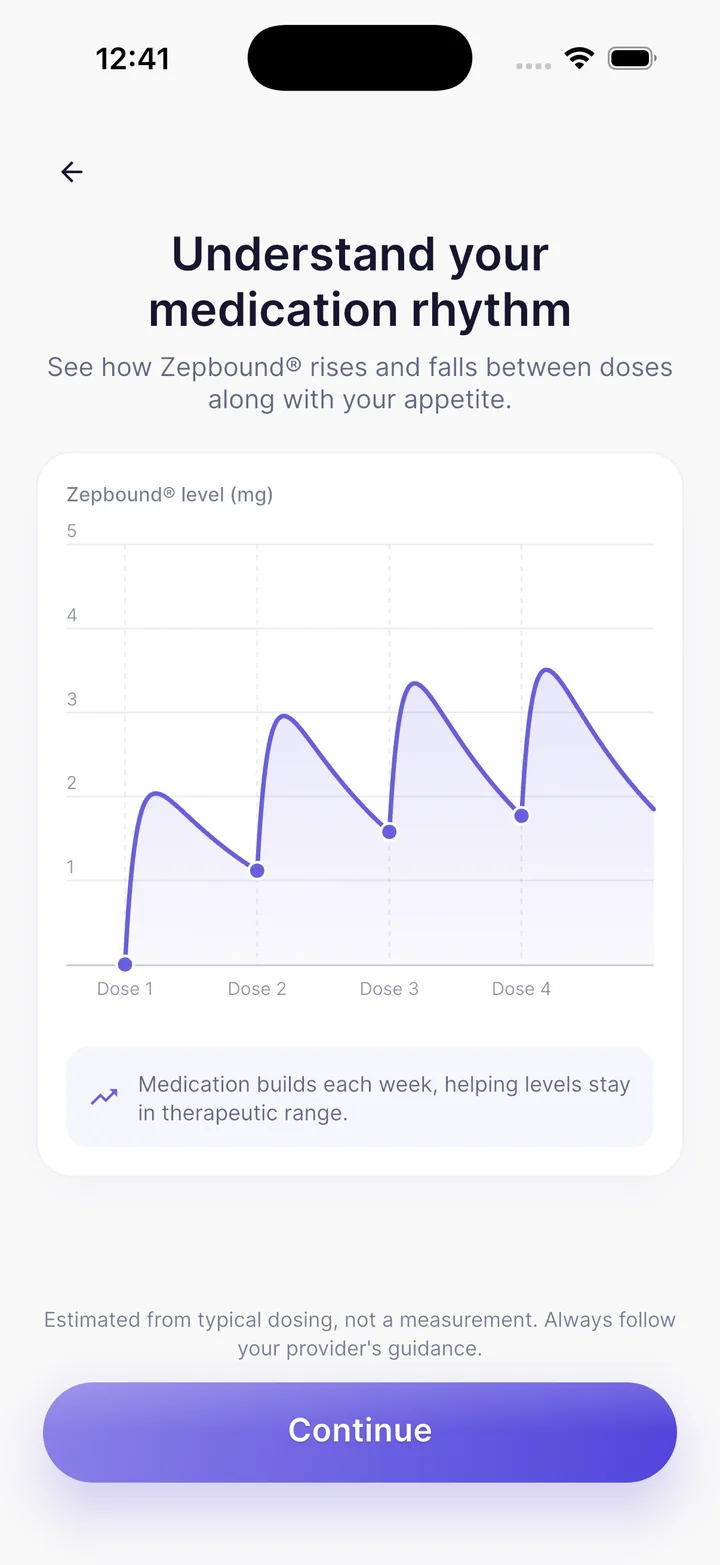
Read the chart as a table
Zepbound 10 mg, last dose on day 42. Modeled amounts absorbed, not blood levels.
| Timepoint | Estimated amount (mg) | % of steady peak |
|---|---|---|
| Day 0 on treatment | 0.00 | 0.0% |
| Day 1 on treatment | 7.0 | 60.8% |
| Day 2 on treatment | 6.3 | 55.2% |
| Day 3 on treatment | 5.5 | 48.1% |
| Day 7 on treatment | 3.2 | 27.6% |
| Day 14 on treatment | 4.4 | 38.1% |
| Day 21 on treatment | 4.8 | 42.1% |
| Day 28 on treatment | 5.0 | 43.6% |
| Day 35 on treatment | 5.1 | 44.1% |
| Day 42, last dose | 5.1 | 44.4% |
| 1 day after the last dose | 11.4 | 99.4% |
| 2 days after the last dose | 10.2 | 88.8% |
| 3 days after the last dose | 8.9 | 77.4% |
| 7 days after the last dose | 5.1 | 44.4% |
| 14 days after the last dose | 1.9 | 16.8% |
| 21 days after the last dose | 0.73 | 6.4% |
| 28 days after the last dose | 0.28 | 2.4% |
Educational estimate, not a blood level or medical advice. Follow your prescriber's instructions.
How long does tirzepatide (Zepbound, Mounjaro) stay in your system?
Tirzepatide has an elimination half-life of about 5 to 6 days on the current Zepbound label (about 5 days on the Mounjaro label), so a Zepbound or Mounjaro dose falls below 5% of its steady level roughly 3 weeks after the last weekly injection. In practical terms, the medication is still doing most of its work a full week after an injection, which is exactly what a weekly schedule relies on: each new dose lands on about half of the previous one.
The label reports peak blood concentration a median of 24 hours after injecting (the range runs 8 to 72 hours), so levels actually rise for the first day or so before the long decline begins. Zepbound and Mounjaro are the same molecule, so everything on this page applies to both brands.
How long does semaglutide (Wegovy, Ozempic, Rybelsus) stay in your system?
Semaglutide has an elimination half-life of approximately 1 week, the longest of the GLP-1 medications. The Wegovy label states that semaglutide remains in circulation for about 5 to 7 weeks after the last 2.4 mg injectable dose; this calculator's 5%-of-steady-level line falls at about 5 weeks, inside that same window.
The one-week half-life belongs to the molecule, not the package: Wegovy 2.4 mg, the higher 7.2 mg Wegovy HD dose, the Wegovy 25 mg daily tablet, Ozempic, and the Rybelsus tablets are all semaglutide, and all clear on the same weeks-long timeline. The tablets are taken daily because of how the oral form is absorbed, not because they leave the body faster: the Rybelsus label states semaglutide is present in circulation for about five weeks after the last tablet dose, and this calculator's curve agrees.
How long do Saxenda and Victoza (liraglutide) stay in your system?
Liraglutide has the shortest half-life of the GLP-1 injections: 13 hours, with peak levels around 11 hours after the daily injection. A stopped course of Saxenda or Victoza is below 5% of its steady level in about 3 days, and regular dosing reaches steady state just as fast, in about 3 days.
That short half-life is why liraglutide is the one injectable dosed daily, and why its labels handle a missed dose by simply resuming the next day rather than making up the dose. Saxenda and Victoza are the same molecule at different doses; liraglutide has also been available as a generic since 2025.
How long does Trulicity (dulaglutide) stay in your system?
Dulaglutide's elimination half-life is approximately 5 days, essentially the same as tirzepatide's, so Trulicity follows the familiar weekly-injection arithmetic: below 5% of its steady level about 3 weeks after the last injection, and close to steady state after about 4 weeks of weekly dosing. Peak levels arrive 24 to 72 hours after injecting, median 48.
How long does Foundayo (orforglipron) stay in your system?
Foundayo is the outlier: orforglipron has a half-life of approximately 29 to 49 hours after an oral dose, with peak levels 4 to 8 hours after taking the pill. At that pace it is essentially out of your system in 7 days, which is why Foundayo is dosed daily; a weekly schedule would leave most of the week uncovered.
The flip side of a short half-life is a fast reset. Where a stopped injection tapers over a month or more, a stopped daily pill is largely gone within days.
How long until levels reach steady state?
Steady state is the point where each new dose only replaces what the body cleared since the last one, so levels stop climbing. The Zepbound label states tirzepatide reaches steady state after 4 weeks of once-weekly dosing. Semaglutide's longer half-life stretches that to about 5 weeks, and Foundayo's short one compresses it to about 8 days.
This is the number behind two common experiences. The first weeks on a weekly injection feel weaker than the label average partly because levels are still climbing: a week after the first tirzepatide dose you are carrying roughly 60% of the eventual steady trough. And every dose increase restarts the same climb at the new height, which is why escalation steps are spaced about a month apart. The first stretch of the chart above, before the last dose, shows the climb for your dose.
Why does the missed dose window differ by medication?
The missed-dose rules in each label are the half-life story in miniature. The Zepbound and Mounjaro labels allow a missed injection to be taken up to 4 days (96 hours) late, and to be skipped after that; Ozempic's label allows 5 days, and Trulicity's says to take it as soon as possible if at least 3 days (72 hours) remain before the next scheduled dose. The Wegovy label uses a 48-hour rule keyed to the next dose. The daily forms barely look back at all: the semaglutide tablets say to skip a missed day, Foundayo says to take a missed pill as soon as possible without doubling up, and the Saxenda and Victoza labels say to resume the once-daily schedule with the next dose (restarting at 0.6 mg after more than 3 days).
The logic is visible in the calculator above: a weekly injection still has roughly half its steady level present a week later, so a day or two of delay lands on a meaningful base. These are the labels' instructions to prescribers, not our advice; if you have missed a dose, your own label and prescriber are the authority.
What does this calculator model, and what does it leave out?
The curve is a standard one-compartment model: absorption at the rate implied by each label's time-to-peak, elimination at the label half-life, and a regular dosing schedule at the label interval. The chart sums the doses from day 0, keeps them going two intervals past steady state, then shows what happens after a last dose, with “below 5%” marked at 5% of the steady peak, roughly four to five half-lives.
The milligrams shown are estimated medication in the body after absorption: the dose, multiplied by the absolute bioavailability each label reports (80% for subcutaneous tirzepatide, 89% for subcutaneous semaglutide, approximately 55% for liraglutide, 47% for dulaglutide at maintenance doses, 77% for oral orforglipron, and only 0.4% to 1% for the semaglutide tablets, where the midpoint 0.7% is used), multiplied by the modeled remaining fraction. It is not a blood concentration, and the tablet figures carry the most uncertainty because their absorption range is wide, which is why they display with a tilde. Because these medications behave proportionally, the dose changes only the scale of the axis, never the shape or the timeline.
What the model leaves out: individual variation (label half-lives are medians), the difference between blood level and appetite effect (which fades on its own timetable), and any personal factors your prescriber would weigh. This is an educational reference, not a stopping, switching, or titration planner: decisions about starting, stopping, switching, or restarting belong with your prescriber.
The GlucoPal app's estimated medication levels chart runs this continuously against your real dose history, so the curve reflects the doses you actually took, on the days you actually took them.
FAQ
Do Zepbound and Mounjaro have the same half-life?
Yes, in practice. Zepbound and Mounjaro are both tirzepatide, the same molecule sold under two brand names. The current Zepbound label gives an elimination half-life of approximately 5 to 6 days in people with overweight or obesity and the Mounjaro label approximately 5 days, a difference in the people studied rather than the medicine, and the roughly month-long clearance timeline applies to both. Which brand you have depends on the indication and country, not the chemistry.
Does a higher dose take longer to leave your system?
Not meaningfully. These medications are eliminated proportionally: the amount cleared per day is a fixed fraction of what remains, so a 15 mg dose and a 2.5 mg dose fall along the same percentage curve. A higher dose means higher absolute levels at every point, but the halving rhythm and the weeks-to-clear timeline are the same.
Is the half-life of Ozempic the same as Wegovy?
Yes. Wegovy and Ozempic are both semaglutide, so the elimination half-life of about 1 week is the same; the brands differ in approved doses and indication. The Wegovy 25 mg daily tablet is also semaglutide with the same roughly one-week half-life, taken daily because of how the oral form is absorbed.
How long after stopping a GLP-1 until it is out of your system?
Working from FDA label half-lives: tirzepatide (Zepbound, Mounjaro) falls below 5% of its steady level about 3 weeks after the last injection, and semaglutide (Wegovy) about 5 weeks; the Wegovy label itself says semaglutide stays in circulation for about 5 to 7 weeks after the last 2.4 mg dose. Foundayo (orforglipron) is much faster, essentially gone in about 7 days.
Why are tablet doses so much bigger than injection doses?
Absorption. The Rybelsus label reports that only 0.4% to 1% of a swallowed semaglutide tablet reaches circulation, against 89% for the injection, so a 14 mg tablet actually delivers well under 1 mg of semaglutide into the body. The calculator accounts for this: it charts the mg absorbed, not the number printed on the tablet. Foundayo is the exception, as orforglipron is a small molecule with 77% oral absorption.
How long does Saxenda (liraglutide) stay in your system?
Liraglutide has the shortest half-life of the GLP-1 injections at 13 hours, so a stopped course of Saxenda or Victoza is below 5% of its steady level in about 3 days. The same speed works in reverse: daily dosing reaches steady state in about 3 days, far faster than the weekly injections.
Why does a missed dose window differ by medication?
The windows track the half-lives. The Zepbound and Mounjaro labels say a missed dose can be taken up to 4 days (96 hours) late, the Wegovy label uses a 48-hour rule tied to the next scheduled dose, and the semaglutide tablets say to skip a missed day, while Foundayo says to take a missed pill as soon as possible. Longer half-life, wider window: levels fall slowly enough that a late weekly injection still lands on a meaningful base. Follow your own label and prescriber.
How long until a GLP-1 reaches steady state?
Steady state is when each new dose replaces what the body cleared since the previous one, so levels stop climbing week over week. The Zepbound label states tirzepatide reaches steady state after 4 weeks of weekly dosing; semaglutide (Wegovy), with its longer half-life, takes about 5 weeks, and Foundayo's short half-life gets the daily pill there in about 8 days. This resets on a dose increase, which is one reason escalation steps are spaced about a month apart.
Does the appetite effect stop as soon as levels fall?
Levels decline gradually rather than switching off: after a last weekly injection, half the steady level is typically still present a week later. Appetite effects fade over the same weeks-long window as the medication clears, which is why any decision about stopping or switching belongs with your prescriber rather than a calendar.
Can you flush a GLP-1 out of your system faster?
No. These medications clear at a fixed proportional rate set by the molecule, and nothing meaningfully accelerates it: not extra water, exercise, or supplements. Time is the only variable. The related idea of a deliberate GLP-1 "washout" or liver-break holiday is not a recognized practice either; long gaps mainly mean losing steady state, and labels handle extended gaps by restarting dose escalation.
Is this calculator free, and do I need to sign up?
Yes, it is free, and no sign-up or email is required. You see the full curve and the estimated clearance timeline instantly for every medication. The GlucoPal iOS app it comes from is also free to download.
By medication
- Zepbound half-lifetirzepatide, about 5 to 6 days
- Mounjaro half-lifetirzepatide, about 5 days
- Wegovy half-lifesemaglutide, about 1 week
- Ozempic half-lifesemaglutide, about 1 week
- Rybelsus half-lifeoral semaglutide, about 1 week
- Foundayo half-lifeorforglipron, 29 to 49 hours
- Saxenda half-lifeliraglutide, 13 hours
- Victoza half-lifeliraglutide, 13 hours
- Trulicity half-lifedulaglutide, about 5 days
Related calculators
Sources
- Zepbound (tirzepatide) FDA prescribing information, DailyMed
- Mounjaro (tirzepatide) FDA prescribing information, DailyMed
- Wegovy (semaglutide) FDA prescribing information, DailyMed
- Ozempic (semaglutide) FDA prescribing information, DailyMed
- Rybelsus (oral semaglutide) FDA prescribing information, DailyMed
- Foundayo (orforglipron) FDA prescribing information, DailyMed
- Saxenda (liraglutide) FDA prescribing information, DailyMed
- Victoza (liraglutide) FDA prescribing information, DailyMed
- Trulicity (dulaglutide) FDA prescribing information, DailyMed
Built and maintained by GlucoPal, the free app for iPhone and Android for tracking GLP-1 weight loss medications. All pharmacokinetic figures were read directly from the current FDA labels on DailyMed on 27 August 2026 and re-checked on 2 October 2026.
You take your GLP-1s. We'll take care of the rest.