GLP-1 Dose Calculator
To turn a GLP-1 dose in mg into syringe units, divide it by your vial's concentration in mg/mL and multiply by 100. A 2.5 mg tirzepatide dose from a 10 mg/mL vial is 25 units on a U-100 insulin syringe. On one medication? Use the tirzepatide or semaglutide dose calculator.
Converts a dose your prescriber set, never suggests one · Free, no sign-up
Your vial and dose
Enter the dose your prescriber set. The tabs are the label strengths for reference; the calculator does not suggest a dose.
GLP-1 mg to units
On a U-100 insulin syringe, for your vial's concentration
Draw for a 2.5 mg tirzepatide dose
25units
0.25 mL of a 10 mg/mL vial
fits a 30-unit (0.3 mL) insulin syringe
100 units = 1 mL on a U-100 insulin syringe, so units = mg ÷ (mg/mL) × 100. Round to the nearest mark on your syringe with your pharmacist.
- Doses per vial
- 8
- 20 mg vial, 2 mL
- Vial lasts
- 8 wk
- at one dose a week
- Per unit
- 0.1 mg
- at 10 mg/mL
| Tirzepatide dose | Units at 10 mg/mL | mL |
|---|---|---|
| 2.5 mg | 25 | 0.25 |
| 5 mg | 50 | 0.5 |
| 7.5 mg | 75 | 0.75 |
| 10 mg | 100 | 1 |
| 12.5 mg | 125 | 1.25 |
| 15 mg | 150 | 1.5 |
Log every draw
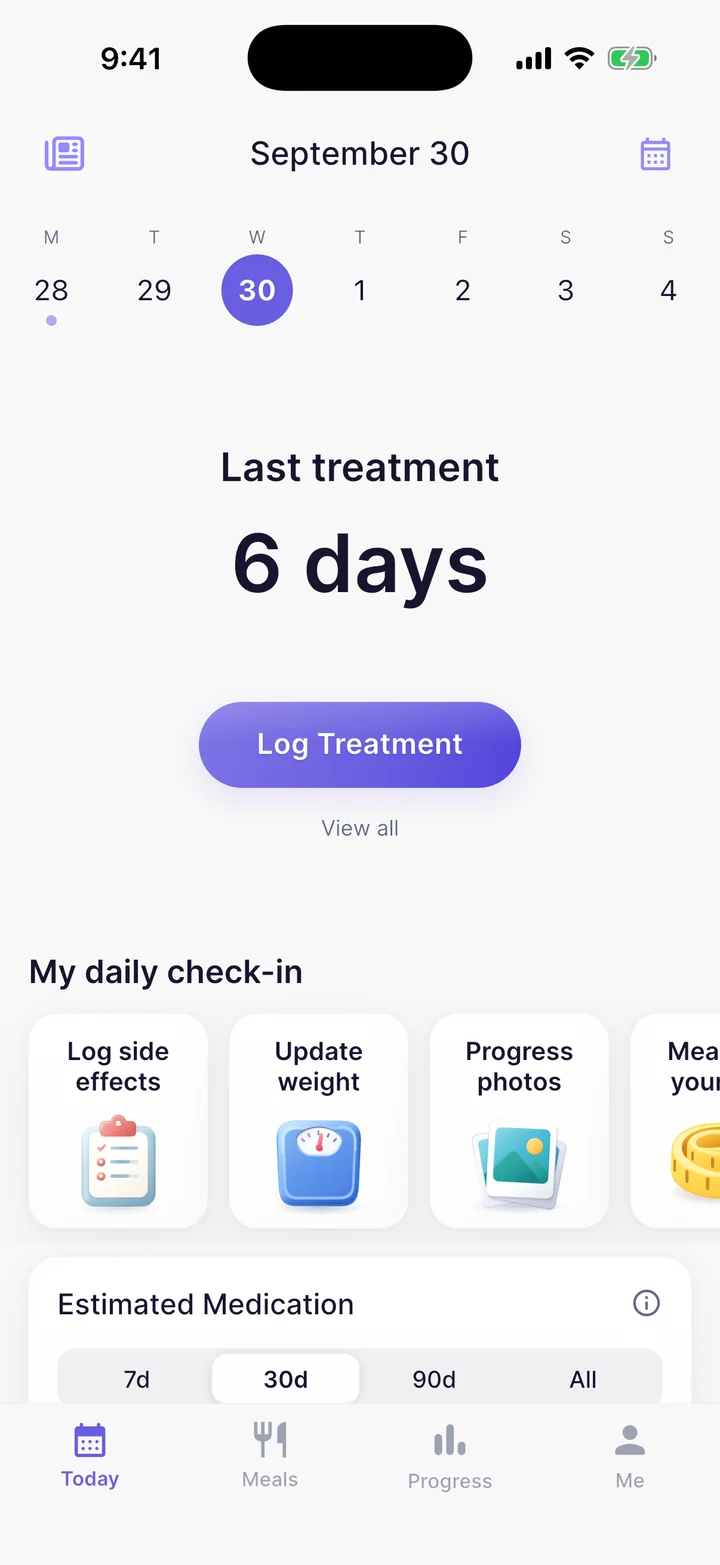
GlucoPal logs compounded tirzepatide by mg dose, with a weekly reminder and an injection-site map.

Quick answer: Units = dose (mg) ÷ concentration (mg/mL) × 100. A 2.5 mg tirzepatide dose from a 10 mg/mL vial is 0.25 mL, which is 25 units on a U-100 insulin syringe; from a 20 mg/mL vial the same dose is 12.5 units. A 0.25 mg semaglutide dose from a 2.5 mg/mL vial is 10 units, and the full 2.4 mg dose from that vial is 96 units. The concentration decides everything, so read it off your own vial before drawing.
Unit conversion only, not medical advice. The dose is whatever your prescriber wrote, the concentration is whatever your vial label says, and this page does the arithmetic between them. Confirm your draw with your pharmacist, and never change a dose on your own.
How do you convert a GLP-1 dose in mg to syringe units?
Compounded GLP-1 comes as a liquid in a vial with a concentration printed on the label, in milligrams per milliliter. Doses are drawn with a U-100 insulin syringe, whose markings are a volume scale: 100 units is 1 mL, so each unit is 0.01 mL. Converting a dose is one line of arithmetic: divide the dose in mg by the concentration in mg/mL to get milliliters, then multiply by 100 to get units.
The same draw holds a different amount of medication at a different concentration, which is the whole reason the concentration field comes first. 25 units is 2.5 mg from a 10 mg/mL vial and 5 mg from a 20 mg/mL vial. If you were switched to a new vial, a new pharmacy, or a different strength, re-run the number rather than reusing last month's units.
When does this calculator not apply?
It does not choose or adjust a dose. Dose escalation for these medications follows the label ladder and your prescriber's judgement; the dose tabs on the calculator are the label strengths for reference only. It also does not apply to the branded pens: Zepbound, Mounjaro, Wegovy, and Ozempic pens deliver a set dose without any unit conversion, and the Zepbound single-dose vials are drawn in full as their instructions describe.
Compounded GLP-1 products are not FDA-approved, and the FDA has received reports of dosing errors with compounded injections, including confusion between units and milligrams. Those reports are the reason this page exists: check the math, then confirm it with the pharmacy that dispensed your vial. Compounded semaglutide and tirzepatide are a US-only option.
How many units is each dose at common concentrations?
The same label ladder at the concentrations pharmacies most often dispense. Cells over 100 units do not fit a single 1 mL insulin syringe. Read the mg/mL on your own vial and use that column; the calculator above handles any other concentration.
| Dose | 10 mg/mL | 17 mg/mL | 20 mg/mL | 30 mg/mL |
|---|---|---|---|---|
| 2.5 mg | 25 units (0.25 mL) | 14.7 units (0.147 mL) | 12.5 units (0.125 mL) | 8.3 units (0.083 mL) |
| 5 mg | 50 units (0.5 mL) | 29.4 units (0.294 mL) | 25 units (0.25 mL) | 16.7 units (0.167 mL) |
| 7.5 mg | 75 units (0.75 mL) | 44.1 units (0.441 mL) | 37.5 units (0.375 mL) | 25 units (0.25 mL) |
| 10 mg | 100 units (1 mL) | 58.8 units (0.588 mL) | 50 units (0.5 mL) | 33.3 units (0.333 mL) |
| 12.5 mg | 125 units (1.25 mL) | 73.5 units (0.735 mL) | 62.5 units (0.625 mL) | 41.7 units (0.417 mL) |
| 15 mg | 150 units (1.5 mL) | 88.2 units (0.882 mL) | 75 units (0.75 mL) | 50 units (0.5 mL) |
| Dose | 1 mg/mL | 2.5 mg/mL | 5 mg/mL |
|---|---|---|---|
| 0.25 mg | 25 units (0.25 mL) | 10 units (0.1 mL) | 5 units (0.05 mL) |
| 0.5 mg | 50 units (0.5 mL) | 20 units (0.2 mL) | 10 units (0.1 mL) |
| 1 mg | 100 units (1 mL) | 40 units (0.4 mL) | 20 units (0.2 mL) |
| 1.7 mg | 170 units (1.7 mL) | 68 units (0.68 mL) | 34 units (0.34 mL) |
| 2.4 mg | 240 units (2.4 mL) | 96 units (0.96 mL) | 48 units (0.48 mL) |
What happens after the draw?
The units are the easy part to lose track of. What matters over a course of treatment is the record: which mg dose you took, on which day, in which injection site, and what happened afterwards. GlucoPal logs compounded tirzepatide and semaglutide by mg dose alongside the branded pens, sends a reminder for the weekly draw, keeps an injection-site rotation map, and turns the history into a doctor-ready PDF for your next appointment.
It is free to download and use, with no account required, and it keeps this calculator company: work out the draw here, log the dose there.
How many units is a tirzepatide dose?
The Zepbound label ladder runs 2.5, 5, 7.5, 10, 12.5, and 15 mg once weekly. At 10 mg/mL those are 25, 50, 75, 100, 125, and 150 units, so the top dose exceeds a 1 mL syringe at that concentration. Pharmacies often dispense higher strengths, commonly 17, 20, or 30 mg/mL, so that every label dose fits one draw: at 20 mg/mL the same ladder is 12.5, 25, 37.5, 50, 62.5, and 75 units.
The tirzepatide dose calculator page has the full table at any concentration, and covers the Zepbound single-dose vials, which are always 0.5 mL and need no conversion.
How many units is a semaglutide dose?
The Wegovy label ladder is 0.25, 0.5, 1, 1.7, and 2.4 mg once weekly. Compounded semaglutide is usually dispensed at 2.5 mg/mL, where the ladder is 10, 20, 40, 68, and 96 units, so everything fits a 1 mL syringe. At 5 mg/mL each number halves: the 2.4 mg dose becomes 48 units.
Because semaglutide doses are small numbers of milligrams, a units-versus-milligrams mix-up is a large proportional error, which is why the semaglutide dose calculator page spends time on reading the vial label.
How many doses are in a vial, and how long does it last?
The calculator divides the vial's total milligrams by your dose and rounds down. A 30 mg tirzepatide vial holds twelve 2.5 mg doses or six 5 mg doses; a 5 mg semaglutide vial holds twenty 0.25 mg doses or two 2.4 mg doses. At one dose a week that is the number of weeks the vial covers, which is useful for lining up refills before the pharmacy's beyond-use date.
Treat the count as an upper bound. A little medication stays in the needle hub and the vial after the last draw, and a vial that lands exactly on a whole number of doses will usually come up a fraction short on the final one.
FAQ
How do I convert a GLP-1 dose in mg to units?
Divide the dose in mg by the vial concentration in mg/mL, then multiply by 100. That gives units on a U-100 insulin syringe, where 100 units is 1 mL. Example: 5 mg from a 20 mg/mL vial is 5 ÷ 20 = 0.25 mL, which is 25 units.
How many units is 2.5 mg of tirzepatide?
It depends on the concentration of your vial. At 10 mg/mL, 2.5 mg is 25 units; at 17 mg/mL it is about 14.7 units; at 20 mg/mL it is 12.5 units. Read the mg/mL on your label and use the calculator above.
How many units is 0.25 mg of semaglutide?
At the common 2.5 mg/mL concentration, 0.25 mg is 10 units (0.1 mL). At 5 mg/mL it is 5 units, and at 1 mg/mL it is 25 units. The pharmacy label is the authority on your vial's concentration.
Can I use this for Zepbound or Wegovy pens?
No, and you do not need to. The Zepbound and Mounjaro KwikPen and single-dose pens, and the Wegovy pen, deliver a fixed dose with no drawing up. Zepbound single-dose vials are 0.5 mL and are drawn in full per the instructions for use. This calculator is for compounded vials dispensed with a concentration on the label.
How many units are in 1 mL?
On a U-100 insulin syringe, 100 units equal 1 mL, so 1 unit is 0.01 mL, 10 units are 0.1 mL, and 50 units are 0.5 mL. The unit markings are a volume scale; how many milligrams they hold depends entirely on the concentration of what is in the vial.
What does U-100 mean on an insulin syringe?
U-100 means the syringe is marked for insulin at 100 units per mL, which is the standard strength in the US. The markings work as a plain volume scale for any liquid, which is why these syringes are used to draw compounded GLP-1 doses from a vial. A 30-unit syringe holds 0.3 mL, a 50-unit syringe 0.5 mL, and a 100-unit syringe 1 mL.
Why do I need the concentration to convert units to mg?
Because units measure volume, not medication. The same 25 units hold 2.5 mg from a 10 mg/mL vial but 5 mg from a 20 mg/mL vial. Always read the mg/mL on your vial label, or work it out from the mg of powder and the mL of water you added, before converting.
Is this calculator free, and do I need to sign up?
Yes, it is free, and no sign-up or email is required. Enter your concentration and dose and the units, mL, and doses per vial update instantly. The GlucoPal iOS app it comes from is also free to download.
Related calculators
- Tirzepatide dose calculatorThe Zepbound ladder in units at any concentration, and the single-dose vials.
- Semaglutide dose calculatorThe Wegovy ladder in units, and how to read a compounded vial label.
- Units to mg converterGo the other way: what a number of syringe units holds at your concentration.
- GLP-1 half-life calculatorHow the doses you draw build to steady state and clear after stopping.
Sources
- Zepbound (tirzepatide) FDA prescribing information, DailyMed
- Wegovy (semaglutide) FDA prescribing information, DailyMed
- FDA: concerns with unapproved GLP-1 drugs used for weight loss (compounded semaglutide and tirzepatide, dosing errors)
Built and maintained by GlucoPal, the free app for iPhone and Android for tracking GLP-1 weight loss medications. Label dose strengths and vial presentations were read from the current FDA labels on DailyMed on 2 September 2026.
You take your GLP-1s. We'll take care of the rest.