Tirzepatide Dose Calculator
Tirzepatide is the molecule in Zepbound and Mounjaro, and compounded tirzepatide is dispensed as a liquid in a vial. Enter the concentration printed on your vial and the dose your prescriber set, and see the draw in units and milliliters, every label dose at that concentration, and how many doses the vial holds.
Converts a dose your prescriber set, never suggests one · Free, no sign-up
Your vial and dose
Enter the dose your prescriber set. The tabs are the label strengths for reference; the calculator does not suggest a dose.
Tirzepatide mg to units
On a U-100 insulin syringe, for your vial's concentration
Draw for a 2.5 mg tirzepatide dose
25units
0.25 mL of a 10 mg/mL vial
fits a 30-unit (0.3 mL) insulin syringe
100 units = 1 mL on a U-100 insulin syringe, so units = mg ÷ (mg/mL) × 100. Round to the nearest mark on your syringe with your pharmacist.
- Doses per vial
- 8
- 20 mg vial, 2 mL
- Vial lasts
- 8 wk
- at one dose a week
- Per unit
- 0.1 mg
- at 10 mg/mL
| Tirzepatide dose | Units at 10 mg/mL | mL |
|---|---|---|
| 2.5 mg | 25 | 0.25 |
| 5 mg | 50 | 0.5 |
| 7.5 mg | 75 | 0.75 |
| 10 mg | 100 | 1 |
| 12.5 mg | 125 | 1.25 |
| 15 mg | 150 | 1.5 |
Log every draw
GlucoPal logs compounded tirzepatide by mg dose, with a weekly reminder and an injection-site map.

Quick answer: Tirzepatide units = dose (mg) ÷ vial concentration (mg/mL) × 100. At 10 mg/mL, 2.5 mg is 25 units, 5 mg is 50 units, and 7.5 mg is 75 units. At 20 mg/mL every number halves: 2.5 mg is 12.5 units and 15 mg is 75 units. A Zepbound single-dose vial is a different case: it is always 0.5 mL (50 units) whatever the strength, and is drawn in full.
Unit conversion only, not medical advice. The dose is whatever your prescriber wrote, the concentration is whatever your vial label says, and this page does the arithmetic between them. Confirm your draw with your pharmacist, and never change a dose on your own.
How do you convert a tirzepatide dose in mg to syringe units?
Compounded tirzepatide comes as a liquid in a vial with a concentration printed on the label, in milligrams per milliliter. Doses are drawn with a U-100 insulin syringe, whose markings are a volume scale: 100 units is 1 mL, so each unit is 0.01 mL. Converting a dose is one line of arithmetic: divide the dose in mg by the concentration in mg/mL to get milliliters, then multiply by 100 to get units.
The same draw holds a different amount of medication at a different concentration, which is the whole reason the concentration field comes first. 25 units is 2.5 mg from a 10 mg/mL vial and 5 mg from a 20 mg/mL vial. If you were switched to a new vial, a new pharmacy, or a different strength, re-run the number rather than reusing last month's units.
When does this calculator not apply?
It does not choose or adjust a dose. Dose escalation for these medications follows the label ladder and your prescriber's judgement; the dose tabs on the calculator are the label strengths for reference only. It also does not apply to the branded pens: Zepbound, Mounjaro, Wegovy, and Ozempic pens deliver a set dose without any unit conversion, and the Zepbound single-dose vials are drawn in full as their instructions describe.
Compounded GLP-1 products are not FDA-approved, and the FDA has received reports of dosing errors with compounded injections, including confusion between units and milligrams. Those reports are the reason this page exists: check the math, then confirm it with the pharmacy that dispensed your vial. Compounded semaglutide and tirzepatide are a US-only option.
How many units is each tirzepatide dose at common concentrations?
The same label ladder at the concentrations pharmacies most often dispense. Cells over 100 units do not fit a single 1 mL insulin syringe. Read the mg/mL on your own vial and use that column; the calculator above handles any other concentration.
| Dose | 10 mg/mL | 17 mg/mL | 20 mg/mL | 30 mg/mL |
|---|---|---|---|---|
| 2.5 mg | 25 units (0.25 mL) | 14.7 units (0.147 mL) | 12.5 units (0.125 mL) | 8.3 units (0.083 mL) |
| 5 mg | 50 units (0.5 mL) | 29.4 units (0.294 mL) | 25 units (0.25 mL) | 16.7 units (0.167 mL) |
| 7.5 mg | 75 units (0.75 mL) | 44.1 units (0.441 mL) | 37.5 units (0.375 mL) | 25 units (0.25 mL) |
| 10 mg | 100 units (1 mL) | 58.8 units (0.588 mL) | 50 units (0.5 mL) | 33.3 units (0.333 mL) |
| 12.5 mg | 125 units (1.25 mL) | 73.5 units (0.735 mL) | 62.5 units (0.625 mL) | 41.7 units (0.417 mL) |
| 15 mg | 150 units (1.5 mL) | 88.2 units (0.882 mL) | 75 units (0.75 mL) | 50 units (0.5 mL) |
What happens after the draw?
The units are the easy part to lose track of. What matters over a course of treatment is the record: which mg dose you took, on which day, in which injection site, and what happened afterwards. GlucoPal logs compounded tirzepatide and semaglutide by mg dose alongside the branded pens, sends a reminder for the weekly draw, keeps an injection-site rotation map, and turns the history into a doctor-ready PDF for your next appointment.
It is free to download and use, with no account required, and it keeps this calculator company: work out the draw here, log the dose there.
What is the Zepbound dose ladder in units?
The Zepbound label starts at 2.5 mg once weekly for four weeks, then 5 mg, with optional steps of 2.5 mg at intervals of at least four weeks up to 15 mg. Compounded tirzepatide prescriptions typically follow the same ladder. At 10 mg/mL the six strengths are 25, 50, 75, 100, 125, and 150 units; at 17 mg/mL they are about 14.7, 29.4, 44.1, 58.8, 73.5, and 88.2 units; at 20 mg/mL, 12.5, 25, 37.5, 50, 62.5, and 75 units.
When a dose steps up, the units step up with it at the same concentration, and a new vial at a different concentration resets the whole table. The calculator's ladder table re-computes for whatever concentration you enter, so a step-up is a matter of reading the next row, not re-doing the arithmetic.
Do Zepbound single-dose vials need this calculator?
The FDA-approved Zepbound vials sold through LillyDirect are single-dose: 2.5 mg, 5 mg, 7.5 mg, 10 mg, 12.5 mg, and 15 mg, each in 0.5 mL. Because the volume is the same for every strength, the draw is always the full vial, 50 units on an insulin syringe, and the strength is set by which vial you were dispensed. The instructions for use cover the draw; there is nothing to convert.
The label describes the vials as single-dose with no preservative, to be discarded after use. That is why this page does not include a vial-splitting tool: the arithmetic would be easy, but it would be arithmetic for something the label says not to do.
What if your tirzepatide vial is a powder you reconstitute?
Some pharmacies dispense tirzepatide as a lyophilized powder with a stated milligram strength and written reconstitution instructions, and the concentration only exists once the bacteriostatic water is added. Switch the calculator to “I mix a powder vial” and enter the mg on the vial and the mL of water the instructions specify: 30 mg in 3 mL is 10 mg/mL, 30 mg in 1.5 mL is 20 mg/mL. Adding more water lowers the concentration and raises the units per dose; it never changes the dose itself. This mode is for a prescription vial with instructions from the dispensing pharmacy, not for research-use products, which are not medicines.
Write the resulting concentration on the vial. The next time you draw, it is the number you need, and a vial reconstituted differently from the last one is the most common way the same units end up holding a different dose.
FAQ
How many units is 5 mg of tirzepatide?
At 10 mg/mL, 5 mg is 50 units (0.5 mL). At 17 mg/mL it is about 29.4 units, and at 20 mg/mL it is 25 units. Divide the dose by your vial's mg/mL and multiply by 100.
How many mg is 40 units of tirzepatide?
40 units is 0.4 mL, and the milligrams depend on the concentration: 4 mg at 10 mg/mL, 6.8 mg at 17 mg/mL, and 8 mg at 20 mg/mL. Multiply the mL by the mg/mL on your vial, or use the units-to-mg converter.
What concentration is compounded tirzepatide?
There is no single standard. Pharmacies commonly dispense 10, 17, 20, or 30 mg/mL, and some use other strengths, so the only reliable source is the label on your own vial. The calculator offers those four as quick picks and accepts any value.
Is 15 mg of tirzepatide one syringe?
Only at a high enough concentration. At 10 mg/mL, 15 mg is 150 units, more than a 1 mL syringe holds; at 20 mg/mL it is 75 units and at 30 mg/mL it is 50 units. The calculator flags any draw that exceeds one 100-unit syringe.
How many units are in 1 mL?
On a U-100 insulin syringe, 100 units equal 1 mL, so 1 unit is 0.01 mL, 10 units are 0.1 mL, and 50 units are 0.5 mL. The unit markings are a volume scale; how many milligrams they hold depends entirely on the concentration of what is in the vial.
What does U-100 mean on an insulin syringe?
U-100 means the syringe is marked for insulin at 100 units per mL, which is the standard strength in the US. The markings work as a plain volume scale for any liquid, which is why these syringes are used to draw compounded GLP-1 doses from a vial. A 30-unit syringe holds 0.3 mL, a 50-unit syringe 0.5 mL, and a 100-unit syringe 1 mL.
Why do I need the concentration to convert units to mg?
Because units measure volume, not medication. The same 25 units hold 2.5 mg from a 10 mg/mL vial but 5 mg from a 20 mg/mL vial. Always read the mg/mL on your vial label, or work it out from the mg of powder and the mL of water you added, before converting.
Is this calculator free, and do I need to sign up?
Yes, it is free, and no sign-up or email is required. Enter your concentration and dose and the units, mL, and doses per vial update instantly. The GlucoPal iOS app it comes from is also free to download.
Related calculators
- GLP-1 dose calculatorTirzepatide and semaglutide side by side, with the label dose ladder for each.
- Semaglutide dose calculatorThe same arithmetic for compounded semaglutide and the Wegovy ladder.
- Units to mg converterGo the other way: what a number of syringe units holds at your concentration.
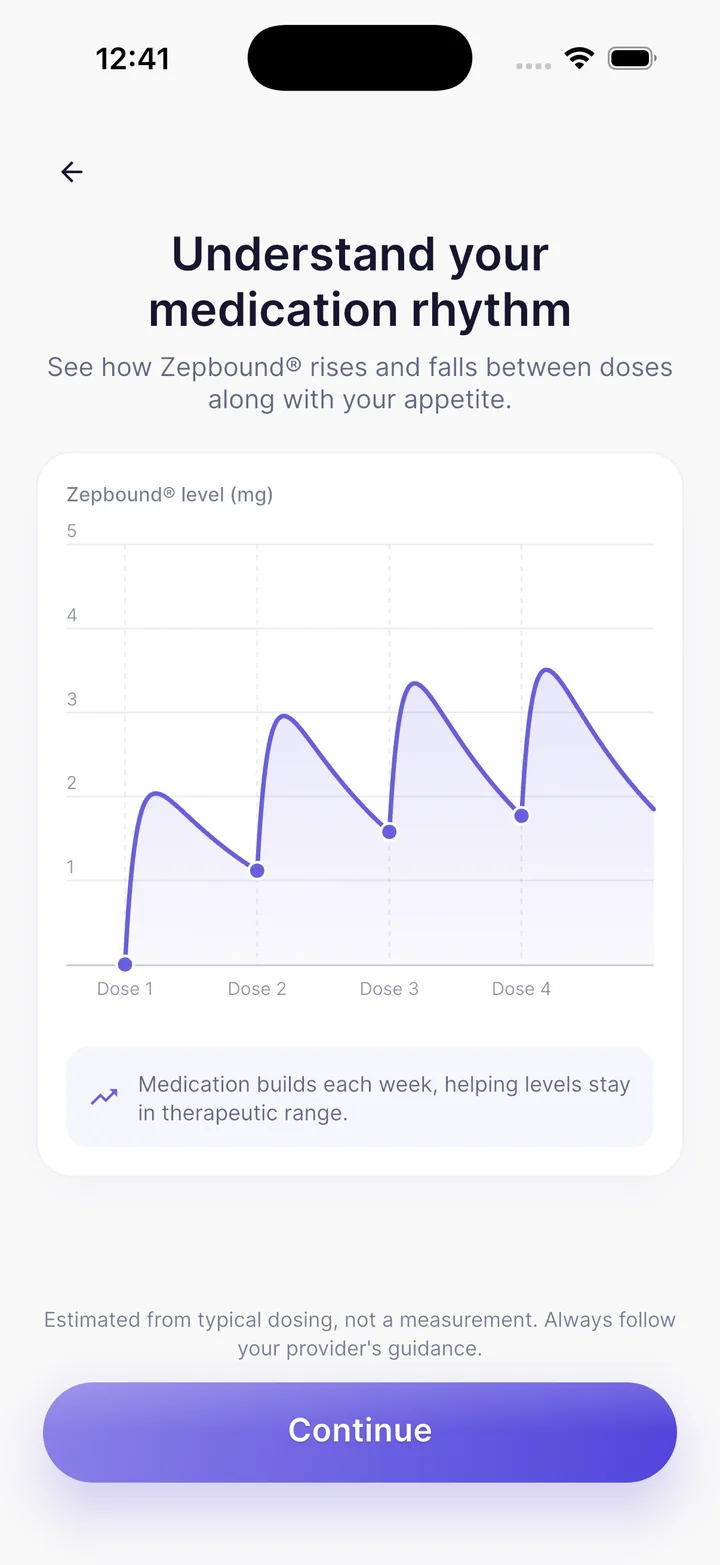
- Zepbound half-life calculatorHow tirzepatide builds to steady state over the first month of weekly doses.
Sources
- Zepbound (tirzepatide) FDA prescribing information, DailyMed
- FDA: concerns with unapproved GLP-1 drugs used for weight loss (compounded semaglutide and tirzepatide, dosing errors)
Built and maintained by GlucoPal, the free app for iPhone and Android for tracking GLP-1 weight loss medications. Label dose strengths and vial presentations were read from the current FDA labels on DailyMed on 2 September 2026.
You take your GLP-1s. We'll take care of the rest.