How Long Does Zepbound Stay in Your System?
Zepbound stays in your system for about a month after the last injection. Tirzepatide's half-life is about 5 to 6 days per the FDA label, so levels fall below 5% of the steady level in about 3 weeks, with traces lasting a little longer.
From the Zepbound FDA label · Free, no sign-up
At a glance
- Half-life
- about 5 to 6 days
- Peak after a dose
- 24 hours
- Steady state
- about 4 weeks
- Below 5% after stopping
- about 3 weeks
See your real levels
GlucoPal charts your estimated level from the doses you actually log.

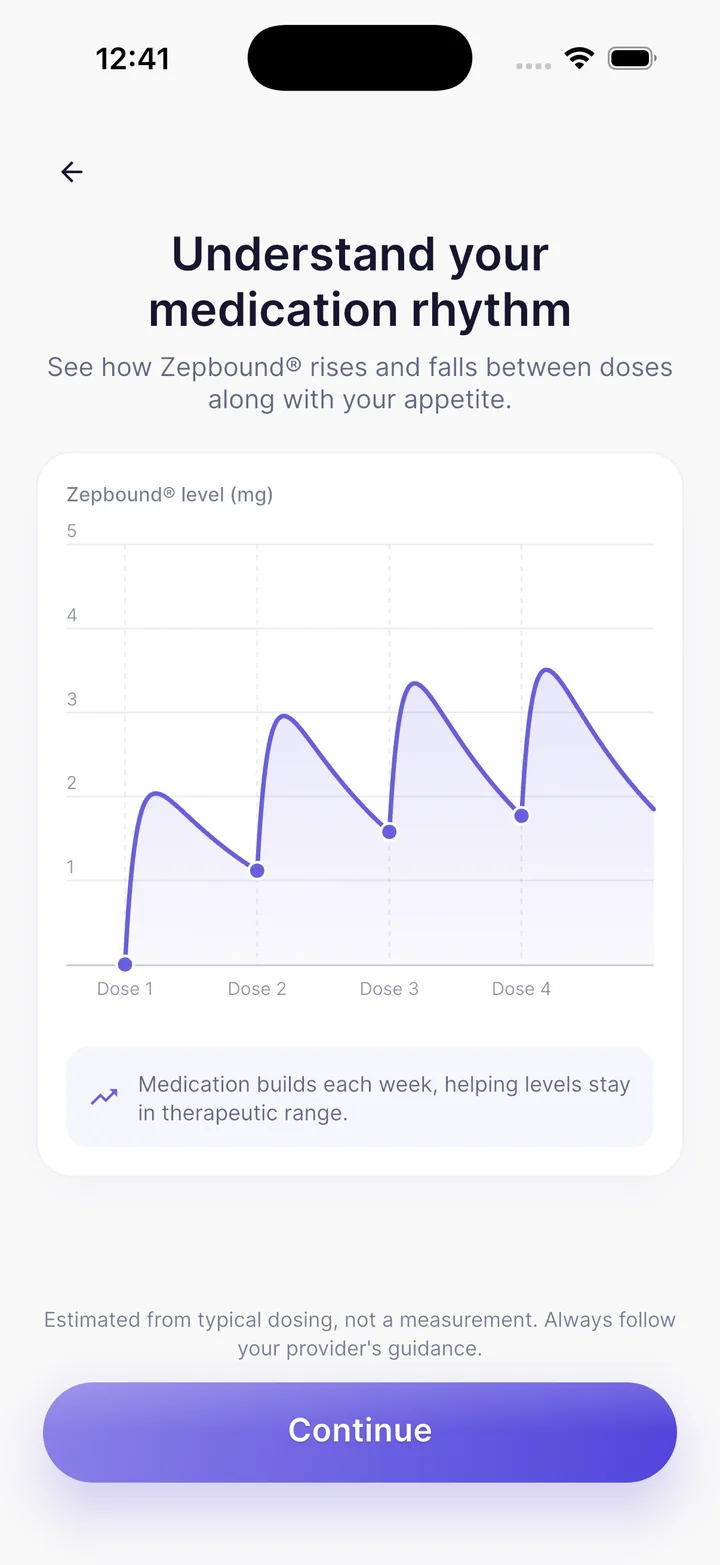
Read the chart as a table
Zepbound 10 mg, last dose on day 42. Modeled amounts absorbed, not blood levels.
| Timepoint | Estimated amount (mg) | % of steady peak |
|---|---|---|
| Day 0 on treatment | 0.00 | 0.0% |
| Day 1 on treatment | 7.0 | 60.8% |
| Day 2 on treatment | 6.3 | 55.2% |
| Day 3 on treatment | 5.5 | 48.1% |
| Day 7 on treatment | 3.2 | 27.6% |
| Day 14 on treatment | 4.4 | 38.1% |
| Day 21 on treatment | 4.8 | 42.1% |
| Day 28 on treatment | 5.0 | 43.6% |
| Day 35 on treatment | 5.1 | 44.1% |
| Day 42, last dose | 5.1 | 44.4% |
| 1 day after the last dose | 11.4 | 99.4% |
| 2 days after the last dose | 10.2 | 88.8% |
| 3 days after the last dose | 8.9 | 77.4% |
| 7 days after the last dose | 5.1 | 44.4% |
| 14 days after the last dose | 1.9 | 16.8% |
| 21 days after the last dose | 0.73 | 6.4% |
| 28 days after the last dose | 0.28 | 2.4% |
Educational estimate, not a blood level or medical advice. Follow your prescriber's instructions.
What is the half-life of Zepbound?
Zepbound's elimination half-life is about 5 to 6 days, per the FDA label: that is how long it takes for the amount of tirzepatide in your body to halve. Levels peak 24 hours (range 8 to 72) after a dose, and on the label schedule (a weekly injection) they reach steady state about 4 weeks after the first dose. After a last dose they fall below 5% of that steady level in about 3 weeks.
Between scheduled doses, levels swing between a peak and a trough of about 44% of that peak, which is why the chart looks like a sawtooth rather than a flat line. The label also reports that 80% of each dose is absorbed into circulation; the chart's mg figures build that in.
What if you miss a dose of Zepbound?
The Zepbound label instructs that a missed dose be taken as soon as possible within 4 days (96 hours), and skipped if more than 4 days have passed, with the next dose on the regular day.
That window is the half-life doing the work: with about 5 to 6 days of half-life, a late dose still lands on a meaningful base. This is the label's instruction to prescribers, not our advice; if you have missed a dose, your own label and prescriber are the authority.
Pausing or stopping Zepbound: what the curve means
Most people who ask how long Zepbound stays in the system are not quitting for good: they are between fills, switching coverage, or told to hold doses before a procedure. The practical read of the curve is that a one-week gap still leaves roughly half your steady level on board, a two-week gap roughly a quarter, and by three weeks the medication is mostly gone.
Appetite effects fade along that same slope rather than switching off, which is why a missed week often feels unremarkable while a missed month does not. Any decision about holding or restarting doses, including before surgery or a procedure, belongs with your prescriber and care team; the arithmetic here is why they ask about your last dose date.
FAQ
Do Zepbound and Mounjaro have the same half-life?
Yes, in practice. Both are tirzepatide, the same molecule under two brand names. The current Zepbound label gives approximately 5 to 6 days in people with overweight or obesity and the Mounjaro label approximately 5 days, a difference in the people studied rather than the medicine, so the 4-week build to steady state and the roughly month-long clearance apply to both.
Does Zepbound build up in your system over time?
Yes, for about the first month. Each weekly injection lands on top of what is left of the previous ones, so the amount of tirzepatide in your body climbs for about 4 weeks and then levels off into a steady rhythm: a peak after each shot and a trough of about 44% of that peak just before the next. After that it stops building; a dose increase restarts the same climb from a higher base.
What is the half-life of Zepbound 2.5 mg?
The same 5 to 6 days as every other strength. Half-life is a property of tirzepatide, not of the pen, so 2.5 mg, 5 mg, and 15 mg all fall along the same percentage curve. What changes with the dose is the amount in your body at every point, not how long it takes to halve.
Why does Zepbound feel weaker right before the next dose?
Two things stack. By the end of the week your level really is at its trough, about 44% of the post-dose peak. But blood level is not the same as felt effect: appetite suppression has its own timetable, and receptors adjust, so the day-6 dip many people report is real without meaning the medication is gone.
Does a higher Zepbound dose take longer to leave your system?
Not meaningfully. Zepbound is eliminated proportionally: the amount cleared per day is a fixed fraction of what remains, so every dose falls along the same percentage curve on the same timeline. A higher dose means more tirzepatide at every point, not a longer goodbye.
Are these numbers my actual blood levels?
No. The curve is a population estimate built from the FDA label's median half-life and absorption figures: anyone who took the same doses on the same days would see the same chart. Individual metabolism runs faster or slower than the median, so treat it as the shape and rough scale of your levels, not a measurement.
Is this calculator free, and do I need to sign up?
Yes, it is free, and no sign-up or email is required. You see the full curve and the estimated clearance timeline instantly. The GlucoPal iOS app it comes from is also free to download.
Related calculators
- Zepbound dosage chartThe label steps from 2.5 mg to 15 mg, on a calendar.
- GLP-1 half-life calculatorAll nine medications side by side: build-up, steady state, and clearance.
- Zepbound weight loss calculatorSURMOUNT-1 averages by dose, mapped to your starting weight.
- Mounjaro half-lifeThe same tirzepatide clock, for UK and Australian readers.
- Tirzepatide dose calculatorYour prescribed mg converted to syringe units for a compounded vial.
Sources
Built and maintained by GlucoPal, the free app for iPhone and Android for tracking GLP-1 weight loss medications. All pharmacokinetic figures were read directly from the current FDA label on DailyMed on 27 August 2026 and re-checked on 2 October 2026.
You take your GLP-1s. We'll take care of the rest.