GlucoPal vs Glapp: Which GLP-1 Tracker Fits Your Routine?
GlucoPal vs Glapp compared on ratings, price, food logging, pills, medication levels, and vial supply, with every figure checked August 14, 2026.

By GlucoPal TeamReviewed 10 min read
GlucoPal and Glapp are both well-rated GLP-1 trackers built for weight loss, and the choice between them comes down to a single question: do you want your meals in the same app as your shots, or do you want the deepest possible read on what the medication itself is doing?
Quick answer: Choose GlucoPal if you want meal-level nutrition, symptoms, progress photos and an exportable record beside doses or pills in one no-account app on iPhone or Android. Choose Glapp if clinical-trial benchmarking, vial inventory with BUD dates or web access is why you track. Both have Android apps; the food-and-progress workflow versus medication inventory is the useful distinction.
| Choose GlucoPal if... | Choose Glapp if... |
|---|---|
| You want meals, sites, symptoms and progress in one record on iPhone or Android, with CSV exports and a Pro provider PDF | You need trial benchmarking, vial inventory or browser access |
The historical competitor rating, price and feature snapshot below was checked against primary sources (both App Store listings, the Google Play listing for `io.glapp`, glapp.io including its own Glapp Max announcement, and Apple's public US customer review feed) on August 14, 2026. Listings change often, so re-check before you download. If you want the wider field rather than a head-to-head, our Glapp alternatives roundup compares five trackers side by side.
Product correction — October 6, 2026
GlucoPal works on iPhone and Android. It supports food search, barcode and photo entry, fat and fiber, body measurements and side-by-side photos. Standard US Pro is $9.99/month or $34.99/year; discounts, trial terms and feature access can vary, so check the in-app offer. Historical competitor ratings, review samples and other checks retain their stated dates.
GlucoPal vs Glapp: what is the difference?
Difference summary: GlucoPal works on iPhone and Android and combines injections or daily pills with meals, progress photos and CSV exports. Pro adds provider PDFs. Its August 14 US rating snapshot was 4.81 from 2,589 ratings. Glapp's August 14 snapshot was 4.74 from 809 US ratings; its published workflow emphasizes medication curves, trial benchmarking and vial inventory rather than food logging. Both are free to download.
The short version
The clearest split is nutrition. GlucoPal logs the meal itself. Glapp logs no food, and says so on its own listing, which suggests pairing it with MyFitnessPal, Happy Scale, or Noom.
| Comparison point | GlucoPal | Glapp |
|---|---|---|
| Current US availability | iPhone and Android | iPhone, iPad, Android, and web, with history synced to your account |
| App Store rating (re-checked August 14, 2026) | 4.81 from 2,589 US ratings; 100,000+ users | 4.74 from 809 US ratings; Google Play 4.5 from 346 ratings, 10,000+ downloads |
| Pricing (re-checked August 14, 2026) | Free to download and use; optional GlucoPal Pro $9.99/mo or $34.99/yr | Free to download; Google Play lists in-app purchases from $4.99 to $39.99 per item; no pricing page published on glapp.io |
| Medication tracking | Zepbound, Mounjaro, Wegovy, Ozempic, Saxenda, Victoza, Trulicity injections, plus compounded tirzepatide, semaglutide, liraglutide, dulaglutide, and retatrutide | Mounjaro, Ozempic, Wegovy, Zepbound, tirzepatide, and semaglutide, with retatrutide added on its Android listing |
| Oral GLP-1 pills | Yes (Wegovy pill, Rybelsus, Foundayo) | Not described on its listings |
| Injection site rotation | Automatic, with a body-map history | "Smart injection site rotation" per both listings |
| Nutrition tracking | Food search, barcode entry, AI meal photo scanning, calories, protein, carbs, fat, fiber, water, and Autopilot Calorie Goals | No food, calorie, protein, or water logging; its listing suggests pairing it with a calorie counter |
| Progress photos | Private progress photos | Not described on its listings |
| Medication-level estimates | Estimated forecast chart (GlucoPal Pro) | Semaglutide and tirzepatide curves, free per its own blog post |
| Clinical-trial benchmarking | Not offered | Yes, against published trial data and peers on the same dose |
| Supply and vial tracking | Not described | Vials, pens, concentration, volume, and BUD dates, auto-deducted per logged shot |
| Daily check-in | Side-effect and symptom journal tied to the dose timeline | Daily check-in covering cravings, mood, energy, bowel movements, sleep, food noise, and hunger |
| Health integration | Apple Health on iPhone; Health Connect on Android | Not described on its iOS listing; Health Connect on Android |
| Data export | CSV exports; provider PDF requires Pro | Weekly in-app progress reports; no export described on its listings |
| Account required | No account required to start | Account-based; its site's calls to action are "Join Free" and "Sign In" |
| Research search | Not offered | Wisdom searches clinical trials and peer-reviewed research |
One row deserves a straight answer rather than a checkmark. On estimated medication levels, Glapp is ahead on access: its July 8, 2026 Glapp Max announcement states that estimated medication levels stay free because the team treats them as "a core feature, not a premium add-on." GlucoPal's estimated medication-level forecast chart is part of the optional GlucoPal Pro subscription.
What the two apps agree on
More is shared between these two apps than the table suggests. Both log dose, date, and injection site with reminders and titration schedules. Both describe automatic injection-site rotation, so neither asks you to remember where the last shot went, which matters because Lilly's own instructions ask patients to rotate sites with each dose.
Both track weight over time and tie side effects to your dosing pattern rather than storing them as loose notes. Both name compounded tirzepatide and semaglutide, not just brand pens, which rules out a large share of general health apps for US users. Both state they do not sell your health data.
The result is that the core weekly loop, log the shot, note how you felt, watch the weight trend, feels similar in either app. The differences show up in what you can do with the rest of your day.
What does GlucoPal do that Glapp does not?
GlucoPal-only summary: Four things GlucoPal describes that Glapp does not describe on its listings or website as of August 14, 2026: food, protein, and water logging with a meal database and AI photo scanning; oral GLP-1 pill tracking; private progress photos, platform health integration, CSV exports and Pro provider PDFs; and the ability to start with no account.
Meals, not just numbers
GlucoPal logs the meal itself. You can search a meal database, snap a photo and let AI meal scanning estimate the macros, or set protein, calorie, and water goals that Autopilot Calorie Goals adjusts to your real activity. Glapp does not log food, calories, protein, or water, and its Android listing frames that as deliberate, positioning Glapp as an add-on to a calorie counter you already use.
That is an honest design choice, not an oversight, but it has a practical cost: two apps, two logins, and no single screen where a low-protein week sits next to the dose that caused the appetite drop. Protein is the axis most people struggle with on a GLP-1, and our guide to hitting protein goals on a GLP-1 covers what that tracking needs to capture week to week. Glapp does log hunger level and food noise, which is genuinely useful, but it measures the appetite, not the food.
Pills as well as shots
GlucoPal tracks the Wegovy pill, Rybelsus, and Foundayo (orforglipron) on a daily schedule as well as weekly injections, which matters if you are moving off a shot or your prescriber is trialing an oral option. Glapp's listings name injectables and their generics only, with no oral GLP-1 option described (checked August 14, 2026).
This is not hypothetical. One reviewer in Apple's public US review feed for Glapp, checked the same day, describes switching to the Wegovy pill and finding the app much less useful afterward. A daily pill has a different rhythm from a weekly injection, and the reminder logic, streak handling, and dose history all have to work differently. Our Wegovy pill tracker guide explains what a daily schedule needs to capture.
Progress photos, health integration and exports
Three GlucoPal features have no equivalent described on Glapp's listings. GlucoPal stores private progress photos, which is often the clearest evidence of change when the scale stalls. GlucoPal supports Apple Health on iPhone and Health Connect on Android, while the August 14 Glapp source check did not describe Apple Health on iOS and did describe Health Connect on Android. Check current supported data fields before relying on either integration.
The third is the export. GlucoPal offers CSV exports, and Pro adds provider PDFs for appointments. Glapp's Android listing describes "weekly progress reports to review with your healthcare provider," which is an in-app report rather than a file, and no PDF or data export is described on its listings or website (checked August 14, 2026). Glapp's own Max announcement puts those Progress Reports on the paid tier.
No account required
GlucoPal does not require you to create an account to start tracking. Glapp is account-based by design: its site's calls to action are "Join Free" and "Sign In," and its privacy section says your history "stays securely with your account."
Neither approach is wrong, and the account is what makes Glapp's sync across iPhone, Android, and the browser possible. It is a real tradeoff rather than a flaw. But if you would rather not attach your GLP-1 history to a login before you have decided whether you like an app, that difference shows up in the first sixty seconds. Both companies state they do not sell user data. Reading each app's privacy and data-use pages before you download is worth the two minutes, as the FTC's consumer guidance on health apps points out.
What does Glapp do that GlucoPal does not?
Glapp workflow summary: Glapp emphasizes benchmarking against clinical-trial data, vial and pen inventory with BUD dates, and account access on the web. Its structured daily check-in records cravings, mood, energy, sleep and bowel movements. GlucoPal also records symptoms and works on Android; compare the actual fields and workflow rather than assuming those are absent.
Clinical-trial and peer benchmarking
Glapp compares your weight loss against published clinical trial outcomes and against other users on the same medication and dose, a view its site calls an "On-track check." No other app in this category does it, and in Apple's public US review feed for Glapp (checked August 14, 2026) it is the single most-cited reason people stay, including among reviewers who are unhappy about pricing. One frames it as thinking they were failing and discovering they were right on track.
If your main anxiety is "am I losing slowly enough to worry," that is a genuinely different product than a log. Glapp pairs it with Wisdom, a search over clinical trials and peer-reviewed research for GLP-1 questions. GlucoPal does not offer either feature. Treat any benchmark as context rather than a verdict, since trial populations, starting weights, and titration schedules differ from yours, and bring the question to your clinician.
Vial supply tracking with BUD dates
Glapp's supply tracker holds vials and pens with concentration, volume, and beyond-use dates, and every logged shot auto-deducts from your remaining supply so you can see when you run out. Doses can be split across vials. GlucoPal does not describe supply tracking.
For anyone on compounded tirzepatide or semaglutide who is drawing from vials, this is the standout feature of the app, and it appears repeatedly in Glapp's recent positive reviews. It solves a problem a dose log genuinely does not: knowing your runway before the pharmacy needs a week of notice. Glapp keeps supply management on its free tier per its own Glapp Max post, which makes it easy to test without committing.
The daily check-in and shot phases
Glapp's daily check-in is a structured prompt covering side effects, cravings, mood, energy, bowel movements, and sleep quality, plus a hunger level and food noise rating used to analyze how well each dose is working. Its "shot phases" feature predicts hunger, craving, and energy shifts across the weekly cycle before they arrive.
GlucoPal logs side effects and symptoms against the dose timeline, which answers the same "is this nausea dose-related" question, but it does not prompt you daily with a fixed checklist or forecast the phase you are entering. If a structured daily ritual is what keeps you logging, Glapp's version is more opinionated. If you prefer to record symptoms when they happen, our guide to tracking GLP-1 side effects covers what to write down either way.
Web access and account sync
Glapp describes iPhone, iPad, Android and browser access with account sync. GlucoPal works on iPhone and Android and requires no account to start. If browser access is essential, confirm Glapp's current web features; Android availability does not settle this comparison.
Two more honest points in Glapp's favor. It is a young app, first released on iOS in March 2026, and it ships fast: version 1.1.22 landed on August 12, 2026, and reviewers repeatedly note unusually responsive developers. Glapp also publishes a large free public calculator suite on its website, including titration planners, split-dose and vial transition calculators, and pen-clicks tools, which you can use whether or not you install anything.
Which one should you pick?
Fit summary: Pick GlucoPal for doses, meals, symptoms, progress photos and an exportable record on iPhone or Android. Pick Glapp for vial inventory, trial benchmarking or browser access. Using both may fit a routine that needs both medication inventory and meal records.
Pick GlucoPal if...
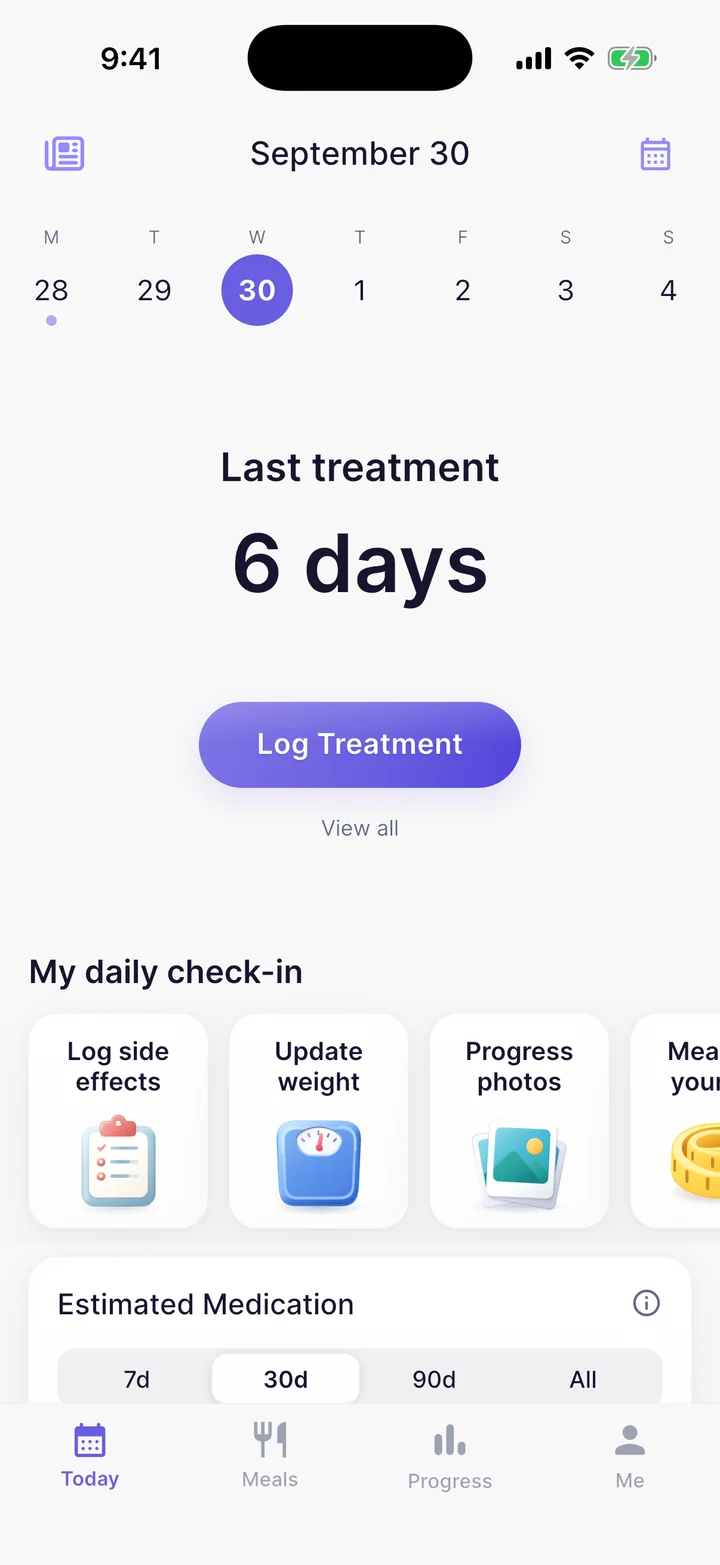
Choose GlucoPal if you want one app to hold the whole routine. It covers brand injections, compounded GLP-1s, and daily pills, adds automatic injection-site rotation on a body map, food search, barcode entry, and AI meal photo scanning, protein and water goals, side effects on the dose timeline, weight trends, private progress photos, Apple Health on iPhone and Health Connect on Android, and CSV exports and Pro provider PDFs.
It is the better pick specifically if food logging is the gap you feel today, if you take or expect to take an oral GLP-1, if progress photos are how you actually measure change, or if you want something organized to hand your clinician. GlucoPal is free to download and use, with an optional GlucoPal Pro subscription at $9.99/mo or $34.99/yr. It works on iPhone and Android; check in-app access for Pro reports and analytics.
Pick Glapp if...
Choose Glapp if you need browser access, vial or pen inventory with BUD dates, or benchmarking against trial results. GlucoPal also serves Android users, so platform availability alone is not a reason to choose Glapp.
Glapp is free to download, its Google Play listing shows in-app purchases from $4.99 to $39.99 per item, and glapp.io publishes no pricing page (all re-checked August 14, 2026). Its Glapp Max post states that shot tracking, weight tracking, supply management, and estimated medication levels stay free, while Progress Reports, Milestones, and Predictions sit on the paid tier. That reads generously by category standards, though the most repeated complaint in Glapp's 49 most recent US App Store reviews (checked August 14, 2026) is that reports and trends people had been using for free moved behind that tier. Both things are true, and they sit inside a 4.74 average.
Why some people run both
Running both apps is a legitimate answer, and Glapp effectively recommends it. Its Android listing tells you to pair it with a food tracker, which means Glapp already expects to be one of two apps on your phone. If you are on an iPhone, GlucoPal plus Glapp gives you meal-level nutrition, pills, photos, and an export on one side, and vial supply plus trial benchmarking on the other.
The cost is duplicate dose entry, since neither app imports from the other. Most people who try this end up logging shots in whichever app they open more often and using the second one weekly. If you would rather not run two, decide which question you ask more: what am I eating, or what is the medication doing.
How do you switch from Glapp to GlucoPal?
Switching summary: Save your Glapp records first, install GlucoPal, enter your current medication and next dose, then start fresh from your next dose day rather than rebuilding months of history by hand. Keep Glapp installed until you are sure nothing important is missing.
No GLP-1 tracker in this category describes an importer that pulls history from another app, and Glapp describes weekly in-app reports rather than a file export, so screenshots are the practical option.
- Open Glapp and review your dose history, titration schedule, recent injection sites, weight trend, side-effect and check-in notes, and current vial or pen supply.
- Screenshot anything you would not want to lose, especially dose history and any symptom patterns you have discussed with your clinician.
- Note your remaining supply and beyond-use date somewhere outside the app before you stop using Glapp's auto-deduction, since GlucoPal does not track vials.
- Install GlucoPal and enter your current medication, dose, schedule, goal, and next dose date. No account creation is required to start.
- Begin logging from your next injection or pill day instead of recreating historical entries, and keep Glapp installed until your next appointment is behind you.
Give yourself a day or two before your next dose to finish setup, because the first entry is where most people quit. If you take a daily oral GLP-1, set that up on day one rather than after your first missed pill.
FAQ
GlucoPal vs Glapp: which should you choose?
Choose GlucoPal for shots or pills, sites, individual meal entries, symptoms, progress photos and an exportable record together. Choose Glapp for vial inventory, trial benchmarking or browser access. Both run on iPhone and Android. Competitor rating and historical feature checks are dated August 14; GlucoPal product facts were corrected October 6, 2026.
Does Glapp track food or calories?
No. Glapp does not log food, calories, protein, or water, and that is a stated design choice rather than a missing feature. Its Google Play listing positions Glapp as an add-on for people already tracking calories in MyFitnessPal, weight trends in Happy Scale, or behavior change with Noom. Glapp does log hunger level and food noise to analyze how each dose is working. If you want meals and shots in one app, GlucoPal includes a meal database, AI meal photo scanning, and protein, calorie, and water goals.
Is Glapp free, and what does Glapp Max add?
Glapp is free to download, and per its own July 8, 2026 announcement, shot tracking, weight tracking, supply management, and estimated medication levels stay on the free tier. Glapp Max adds weekly Progress Reports, Milestones tied to peer-reviewed research, and Predictions such as a personalized goal-date forecast. Glapp publishes no pricing page on glapp.io; its Google Play listing shows in-app purchases from $4.99 to $39.99 per item (re-checked August 14, 2026). Our best free GLP-1 tracker apps guide compares free tiers across the category.
Which app is better for tracking Zepbound or Mounjaro?
Both track Zepbound and Mounjaro, including compounded tirzepatide. GlucoPal is the better fit if you also want the meal, protein, and water side of tirzepatide tracking, progress photos, and CSV exports and Pro provider PDFs in the same app. Glapp is the better fit if you are drawing from compounded vials and want supply tracking with BUD dates, or if you want your tirzepatide results compared against published trial data. For the wider field, see our roundup of the best Zepbound tracker apps.
Does GlucoPal work on Android?
Yes. GlucoPal is available on Google Play as well as iPhone. Glapp also runs on Android and offers account-based web access. Compare meal logging, exports, inventory and benchmarking for your routine; check current Android feature access before paying.
Sources
- App Store - Glapp: Smart GLP-1 Tracker - 4.74 average from 809 US ratings, March 2026 first release, version 1.1.22 released August 12 2026, iPhone and iPad support, smart injection site rotation, medication level curves, shot phases, daily check-in, clinical-trial benchmarking, Wisdom research search, and vial supply tracking with BUD dates (checked August 14, 2026)
- Google Play - Glapp - 4.5 average from 346 ratings, 10,000+ downloads, in-app purchases from $4.99 to $39.99 per item, Health Connect sync, retatrutide support, weekly progress reports for healthcare providers, and its positioning as an add-on to MyFitnessPal, Happy Scale, or Noom with no food or calorie logging
- Glapp official website - account-based "Join Free" and "Sign In" access, history stored with your account, cross-device sync across iPhone, Android, and web, the "On-track check" benchmarking description, the free public calculator suite, and the absence of a pricing page (checked August 14, 2026)
- Glapp - What's Included in Glapp Max? - published July 8 2026; states shot tracking, weight tracking, supply management, and estimated medication levels remain free as "a core feature, not a premium add-on," and that Progress Reports, Milestones, and Predictions are Glapp Max features
- Apple customer review feed - Glapp - recurring themes in the 49 most recent US App Store reviews, including previously free reports and trends moving behind a paid tier, clinical-trial benchmarking as the most-cited reason people stay, vial supply tracking, developer responsiveness, and one reviewer's account of switching to the Wegovy pill (checked August 14, 2026)
- App Store - Zepbound Tracker by GlucoPal - iPhone availability, 4.81 average from 2,589 US ratings, supported injections, compounded GLP-1s and oral pills, automatic injection-site rotation with a body map, meal database and AI meal scanning, progress photos, Apple Health sync, doctor export, and its no-account and no-data-selling statements (checked August 14, 2026)
- GlucoPal official website - product positioning, iPhone availability, 100,000+ users, GlucoPal Pro pricing at $9.99/mo or $34.99/yr, and the feature overview including Autopilot Calorie Goals and the estimated medication-level forecast chart
- FTC Consumer Advice - Does your health app protect your sensitive info? - consumer guidance on reviewing health app privacy and data-use practices before download
About the GlucoPal Editorial Team: GlucoPal makes the app discussed on this website. Our guides use product experience, FDA labels, manufacturer instructions, and the sources cited in each article. Editorial review is not clinical review. Read our editorial and corrections policy.
For information only, not medical advice. Talk to your prescriber before changing your medication or treatment plan.
Built for your weight-loss journey.
GlucoPal helps you log doses, rotate injection sites, and track symptoms for Zepbound, Wegovy, and Mounjaro in seconds.


Free to download and use · Optional Pro · iPhone and Android
Continue reading
All articlesMyFitnessPal GLP-1 Support vs GlucoPal: Should You Just Use MyFitnessPal? (2026)
MyFitnessPal GLP-1 Support vs GlucoPal compared on dose logging, injection sites, side effects, food tracking, exports, and price, checked against primary sources.
Noom GLP-1 vs GlucoPal: Program or Tracker? (2026)
Noom GLP-1 vs GlucoPal compared: Noom Med is a telehealth program, GlucoPal is the daily record. Tracking, exports, medication coverage, and pricing.
Lilly Health vs GlucoPal: The Official Zepbound App Compared (2026)
Lilly Health vs GlucoPal compared on medication coverage, food logging, side effects, injection sites, exports, and privacy, verified against both App Store listings.